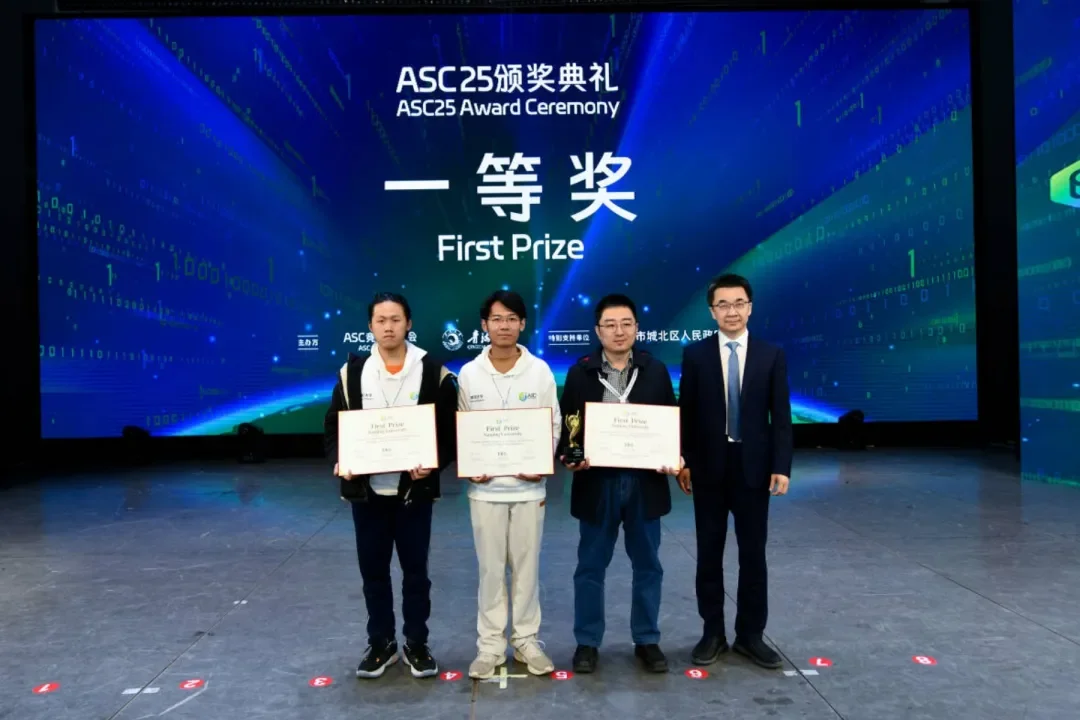
The ASC25 Student Supercomputer Challenge, one of the world’s premier competitions for high-performance computing (HPC), concluded its finals at Qinghai University in Xining, China. After five days of intense competition, the team from Shanghai Jiao Tong University claimed the championship title, while Peking University secured the silver prize. Both teams showcased exceptional expertise in HPC, artificial intelligence (AI), and scientific problem-solving, highlighting the next generation’s potential to drive innovation in technology and science.
More than 300 university teams from around the globe registered for ASC25, with only 25 finalists advancing to compete at Qinghai University—a venue notable for being the highest-altitude location in the competition’s history. The final round challenged participants to design and deploy small-scale supercomputing clusters within a strict 4,000-watt power consumption limit. Teams were tasked with optimizing performance on internationally recognized benchmarks such as HPL (High-Performance Linpack) and HPCG (High-Performance Conjugate Gradient), as well as tackling advanced real-world applications like AlphaFold3 inference acceleration, RNA 5-methylcytosine modification site detection, DeepSeek inference, and cosmic neutrino detection simulations.
In addition to technical tasks, teams delivered English-language oral defenses before a jury of over ten globally renowned experts in HPC and scientific applications. Collaboration was also emphasized through the Group Competition, where finalist teams were randomly grouped into five teams to address a complex scientific challenge: numerical simulation of the Qinghai-Tibet Plateau climate.
The competition was marked by remarkable intensity and innovation, with all 25 finalist teams excelling in areas such as system architecture design, power efficiency, application optimization, collaborative problem-solving, and presentation skills.
One of the highlights of ASC25 was the e Prize Challenge, focused on AlphaFold3 inference optimization. The team from Shanghai Jiao Tong University implemented advanced system-level and algorithmic optimizations, including framework migration, matrix algorithm refinement, task decomposition, parallel computing strategies, and communication acceleration. Their efforts enabled efficient multi-node inference of AlphaFold3 on a general-purpose CPU-based cluster, earning them the top score in this challenge and securing the prestigious e Prize.
The Group Competition Award went to a collaborative team comprising students from Sun Yat-sen University, Peking University, Beijing Normal University, Fuzhou University, and National Taiwan University. Their exceptional coordination and inter-institutional collaboration resulted in the highest score in the Qinghai-Tibet Plateau climate simulation challenge, underscoring the importance of teamwork in addressing complex scientific problems.
Teams from Zhejiang University, Fuzhou University, and Qilu University of Technology were honored with the Application Innovation Award for their creative approaches to solving specific challenges and optimizing application performance. Their contributions exemplified the spirit of innovation that defines the ASC competition.
Jack Dongarra, Chair of the ASC Advisory Committee, Turing Award winner, and Emeritus Professor at the University of Tennessee, praised the event as more than just a competition. “The ASC Student Supercomputer Challenge is a platform connecting global students, mentors, and industry leaders,” he said. “It ignites new possibilities through knowledge, creativity, and cutting-edge technologies. The courage to tackle complex challenges and the spirit of cross-border collaboration fuel students’ drive to explore, innovate, and achieve personal breakthroughs.”
Shi Yuanchun, President of Qinghai University, echoed this sentiment, emphasizing the competition’s role in fostering global collaboration and scientific advancement. “This event serves as a bridge for mutual learning among civilizations,” he stated. “By hosting ASC25, Qinghai University has demonstrated its commitment to progress and innovation. Looking ahead, we will collaborate with global partners to address major scientific challenges and drive breakthroughs in supercomputing technologies.”
The ASC25 Student Supercomputer Challenge not only celebrated the achievements of young innovators but also underscored the importance of HPC and AI in solving real-world problems. From advancing biological research to simulating climate patterns, the competition highlighted how technology can be harnessed to address humanity’s most pressing challenges.
As the dust settles on this year’s event, the legacy of ASC25 continues to inspire. By bringing together bright minds from diverse backgrounds, the competition fosters a culture of collaboration, innovation, and excellence—ensuring that the next generation of scientists and engineers is well-equipped to tackle the complexities of tomorrow’s world.