CES 2025: NVIDIA CEO Unveils Groundbreaking AI Innovations Across Industries
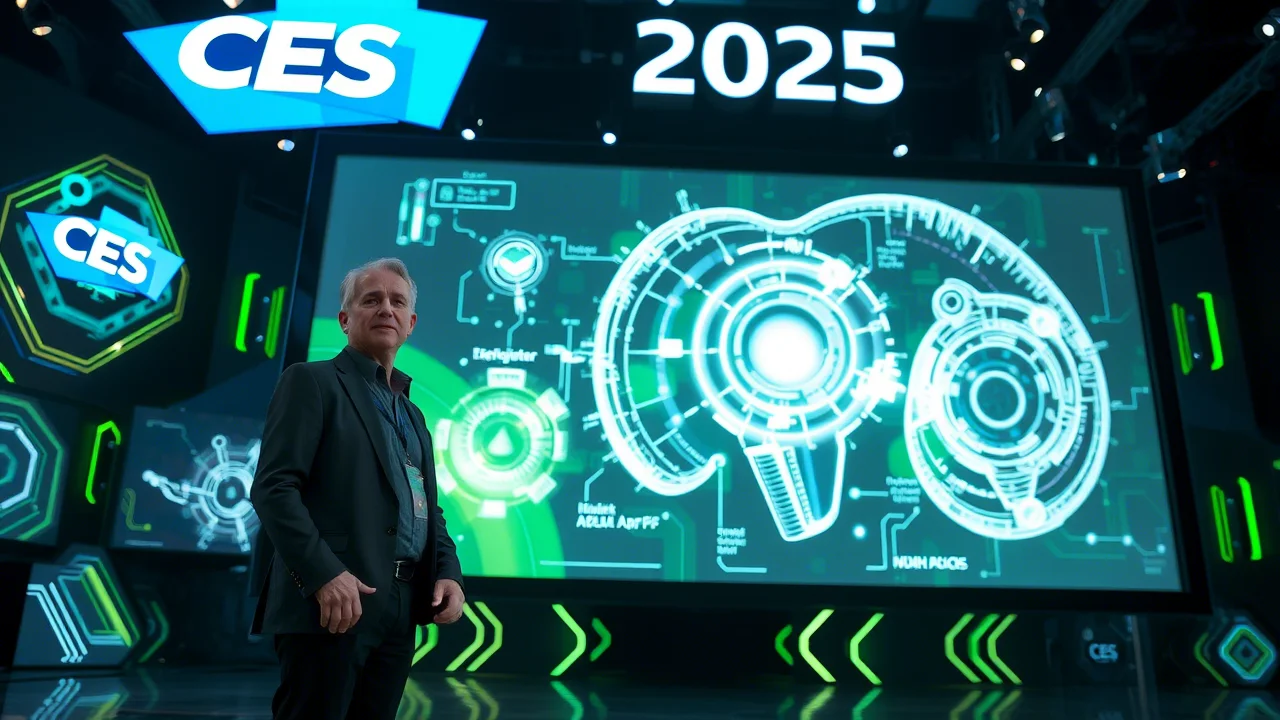
NVIDIA founder and CEO Jensen Huang delivered a compelling 90-minute keynote at CES 2025, showcasing the rapid advancements in artificial intelligence (AI) and how NVIDIA’s cutting-edge technologies are transforming industries like gaming, robotics, autonomous vehicles, and agentic AI. With over 6,000 attendees in Las Vegas, Huang emphasized that AI is advancing at an “incredible pace,” moving from perception AI to generative AI and now entering the era of “physical AI” — systems capable of reasoning, planning, and acting.
Huang unveiled several groundbreaking innovations during his keynote, reinforcing NVIDIA’s leadership in driving AI transformation across multiple sectors.
The newly announced NVIDIA Cosmos platform is set to revolutionize physical AI by enabling advanced models and video data processing pipelines for robots, autonomous vehicles, and vision AI. Cosmos integrates generative models, tokenizers, and video processing pipelines to power AI systems that can predict and evaluate future scenarios, making it a critical tool for robotics and industrial AI.
Leading companies like Toyota, Uber, and XPENG are already adopting Cosmos, which is available as open-source on GitHub. This platform allows developers to create detailed virtual environments tailored for robotics and autonomous vehicle simulations, significantly expanding training datasets.
Huang introduced the GeForce RTX 50 Series GPUs, powered by the new Blackwell architecture, as the most powerful GPUs NVIDIA has ever created. The flagship GeForce RTX 5090 boasts 92 billion transistors and delivers 3,352 trillion AI operations per second (TOPS).
Key features include:
Desktop GPUs like the RTX 5090 and RTX 5080 will be available starting January 30, with additional models rolling out in February and March. These innovations bring AI-driven graphics to the masses, setting a new standard for gaming realism.
NVIDIA is empowering developers with AI foundation models designed for RTX PCs. These models, offered as NVIDIA NIM microservices, enable creators to craft digital humans, podcasts, images, and videos with ease. Huang highlighted their versatility, noting they can run on any cloud or OEM system, making AI tools accessible to everyone.
Additionally, NVIDIA introduced AI Blueprints, which allow developers to build custom AI agents for automating enterprise workflows. These blueprints integrate NVIDIA AI Enterprise software with platforms like CrewAI and LangChain, streamlining tasks like customer support, fraud detection, and supply chain optimization.
Huang announced the NVIDIA DRIVE Hyperion AV platform, built on the new AGX Thor system-on-a-chip (SoC). This end-to-end solution combines advanced sensors, safety systems, and generative AI models to deliver functional safety and autonomous driving capabilities.
Toyota, the world’s largest automaker, will leverage the DRIVE AGX Orin platform for its next-generation vehicles, running on NVIDIA’s safety-certified DriveOS operating system. Synthetic data generated through NVIDIA Omniverse and Cosmos will play a crucial role in training autonomous vehicles, scaling hundreds of drives into billions of effective miles.
In a surprise reveal, Huang introduced Project DIGITS, NVIDIA’s smallest yet most powerful AI supercomputer. Powered by the GB10 Grace Blackwell Superchip, this device runs the entire NVIDIA AI stack and is designed for every developer, engineer, and creative professional. Slated for release in May, Project DIGITS represents the culmination of NVIDIA’s decade-long journey in AI supercomputing.
Huang emphasized that NVIDIA’s innovations are paving the way for rapid breakthroughs in general robotics and digital manufacturing. The NVIDIA Isaac GR00T Blueprint for synthetic motion generation will help developers train humanoid robots using imitation learning, while tools like Mega blueprint enable large-scale simulations for warehouse automation.