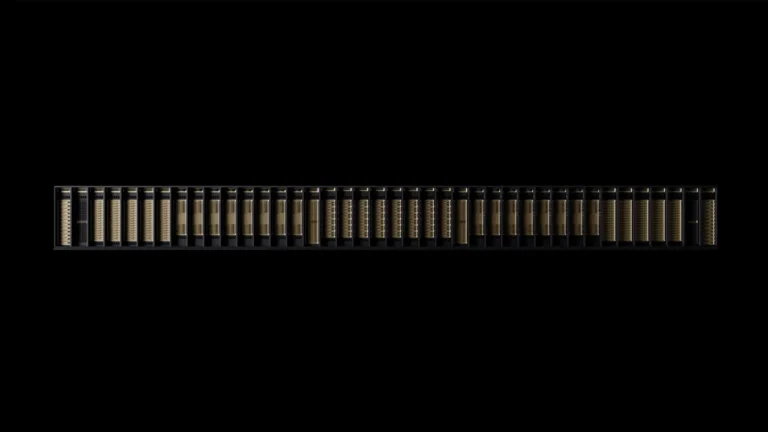

Lightmatter, a pioneer in photonic (super)computing, has unveiled a groundbreaking milestone in optical communications: the world’s first 16-wavelength bidirectional Dense Wavelength Division Multiplexing (DWDM) optical link operating on a single strand of standard single-mode (SM) fiber. Powered by Lightmatter’s industry-leading Passage™ interconnect and Guide™ laser technologies, this innovation shatters existing limitations in fiber bandwidth density and spectral utilization, setting a new benchmark for high-performance, resilient data center interconnects.
As artificial intelligence (AI) workloads continue to grow in complexity—particularly with the rise of trillion-parameter Mixture of Experts (MoE) models—the scalability of AI infrastructure is increasingly constrained by bandwidth and radix (I/O port count) limitations. Lightmatter’s Passage technology delivers an unprecedented 800 Gbps of bidirectional bandwidth (400 Gbps transmit and 400 Gbps receive) per single-mode fiber over distances of several hundred meters or more. This leap forward simultaneously increases both radix and bandwidth per fiber, surpassing the capabilities of existing co-packaged optics (CPO) solutions.
While commercial bidirectional (BiDi) transmission on a single fiber has traditionally been limited to just two wavelengths, achieving 16 wavelengths (or “lambdas”) has historically required multiple or specialized fibers. Lightmatter’s breakthrough addresses significant technical challenges, including managing complex wavelength-dependent propagation characteristics, power budget constraints, optical nonlinearity, and mitigating crosstalk and backscattering on a single fiber. These innovations pave the way for the next wave of advancements in AI model development, which demand more extensive and efficient high-bandwidth networking than current systems can provide.
“Data centers are the new unit of compute in the AI era, with the next 1,000X performance gain coming largely from ultra-fast photonic interconnects,” said Nicholas Harris, founder and CEO of Lightmatter. “Our 16-lambda bidirectional link represents an architectural leap forward. Hyperscalers can now achieve significantly higher bandwidth density using standard single-mode fiber, reducing both capital expenditure and operational complexity while enabling higher ‘radix’—more connections per XPU or switch.”
The implications of this achievement are profound. By dramatically increasing bandwidth density on existing single-mode fiber, Lightmatter’s technology addresses one of the most pressing challenges in AI infrastructure: scalability. Analyst Alan Weckel of 650 Group emphasized the significance of this breakthrough, stating, “Lightmatter’s innovation arrives at a pivotal moment for hyperscale AI infrastructure. The ability to increase bandwidth density on cost-effective single-mode fiber, coupled with robust thermal performance, is a game-changer for data center scalability and efficiency. This breakthrough brings advanced Co-Packaged Optics a giant step closer to market.”
Lightmatter’s success in achieving this milestone is underpinned by several proprietary innovations. A key advancement is its closed-loop digital stabilization system, which actively compensates for thermal drift, ensuring continuous, low-error transmission even under wide temperature fluctuations. Additionally, architectural enhancements make the Passage 3D CPO platform inherently polarization-insensitive. Standard single-mode fiber does not maintain light’s polarization state, unlike more expensive polarization-maintaining (PM) fiber. By achieving polarization insensitivity, Lightmatter enables the use of cost-effective SM fiber for its cutting-edge bidirectional DWDM technology, reducing costs while maintaining high performance.
This combination of unparalleled fiber bandwidth density, efficient spectral utilization, and robust performance positions Lightmatter’s Passage technology as a cornerstone for the industry’s transition from electrical to optical interconnects in AI data centers. It empowers customers to build larger, more capable AI models with more powerful, efficient, and scalable data centers.
The demand for AI-driven innovation continues to accelerate, with organizations striving to develop increasingly sophisticated models that require massive computational resources. Traditional data center architectures, however, are struggling to keep pace with these demands due to bottlenecks in bandwidth and connectivity. Lightmatter’s 16-lambda bidirectional link directly addresses these challenges, enabling hyperscalers and enterprises to scale their AI infrastructure without compromising performance or efficiency.
By leveraging standard single-mode fiber, Lightmatter’s solution avoids the need for costly upgrades to specialized fiber infrastructure. This approach not only reduces capital expenditures but also simplifies deployment and maintenance, making it easier for organizations to adopt cutting-edge optical interconnects. Furthermore, the increased radix and bandwidth density provided by Lightmatter’s technology enable data centers to support more connections per switch or processing unit, enhancing overall network flexibility and scalability.
Lightmatter’s breakthrough underscores the critical role of photonics in advancing AI infrastructure. As the industry shifts toward optical interconnects, solutions like Passage will play a foundational role in enabling the next generation of AI applications. From autonomous systems to natural language processing and beyond, the ability to move vast amounts of data quickly and efficiently is essential for unlocking the full potential of AI.
This innovation also highlights Lightmatter’s leadership in photonic computing and optical communications. By pushing the boundaries of what is possible with single-mode fiber, the company is driving the industry toward a future where high-performance, energy-efficient data centers are the norm rather than the exception.
About Lightmatter
Lightmatter is leading the revolution in AI data center infrastructure, enabling the next giant leaps in human progress. The company’s groundbreaking Passage™ platform—the world’s first 3D-stacked silicon photonics engine—connects thousands to millions of processors at the speed of light. Designed to eliminate critical data bottlenecks, Lightmatter’s technology enables unparalleled efficiency and scalability for the most advanced AI and high-performance computing workloads, pushing the boundaries of AI infrastructure.
Lightmatter, Passage and Guide are trademarks of Lightmatter, Inc.