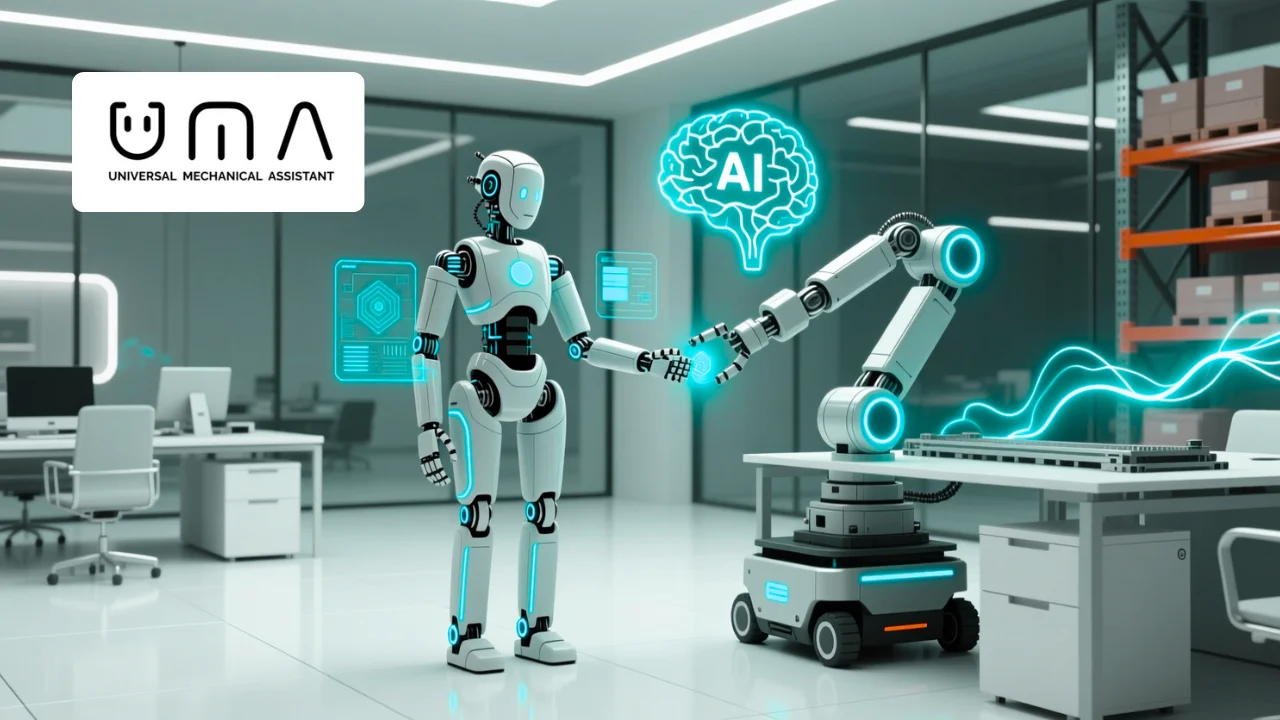
Today marks the launch of UMA (Universal Mechanical Assistant), a groundbreaking robotics intelligence company founded by former leaders from Tesla, Google DeepMind, Nvidia, and Hugging Face. UMA’s mission is clear: to bring advanced artificial intelligence into the physical world by building humanoid robots capable of performing real work in real environments at scale. The company represents a pivotal shift in AI development—from digital intelligence on screens to physical autonomy in dynamic, human-centric spaces.
The past decade has been dominated by breakthroughs in generative models, multimodal systems, and language-based AI. However, the next decade will be defined by robotics, where AI is no longer confined to virtual environments but operates in warehouses, hospitals, labs, factories, and homes. These settings are inherently unpredictable, requiring machines to navigate friction, complexity, and human interaction seamlessly.
UMA’s founders, who have been instrumental in shaping the last decade of AI and robotics advancements, believe that this transition demands a new kind of robotic intelligence. This intelligence must be data-driven, adaptable, self-improving, and safe enough to work alongside humans. UMA is purpose-built to meet these challenges, bridging the gap between digital innovation and physical application.
UMA’s founding team comprises some of the brightest minds in AI and robotics, with decades of collective experience across the globe:
Together, they bring unparalleled technical expertise and a shared vision: to build robots that aren’t just impressive in demonstrations but reliable and effective in real-world production environments.
The need for advanced robotics is driven by pressing industrial and societal pressures. These challenges are not abstract—they directly impact global supply chains, healthcare systems, and aging populations.
UMA envisions robotics as a lever for resilience, empowering machines to handle physical strain, repetitive tasks, and environmental unpredictability so humans can focus on higher-value, creative, and interpersonal work.
UMA is developing two complementary robotic systems designed to address diverse operational needs:
These systems offer a pragmatic path toward high-reliability robotics deployment, balancing cutting-edge innovation with practical operational needs.
UMA’s philosophy is deeply rooted in durability, safety, and real-world performance. The company prioritizes designing lightweight, repairable systems with a commitment to civilian use. UMA believes that robotics should enhance human capabilities, bringing more safety, time savings, and new possibilities to everyday life.
To achieve its ambitious goals, UMA is assembling a world-class team of engineers, researchers, and operational specialists from around the globe. The company values diversity and high standards, fostering an environment where innovation thrives on varied perspectives and backgrounds.
UMA is backed by prominent global investors, including Greycroft, Relentless, Unity Growth, >Commit, Factorial, ALM Ventures, and Drysdale. Additionally, the company has garnered support from leading figures in AI, such as Olivier Pomel, Yann LeCun, Thomas Wolf, Soumith Chintala, and Nicolas Rosberg.
About UMA
Founded in Paris in 2025, UMA develops mobile and humanoid robots powered by advanced physical intelligence and designed for real-world performance. Its team brings experience from Tesla, Google DeepMind, Nvidia and Hugging Face. Backed by a significant first round, UMA is accelerating development and preparing pilot programs in logistics, manufacturing and healthcare in 2026. UMA’s vision is to deliver intelligent robots that make work safer, that improve productivity, and make daily life better for millions.