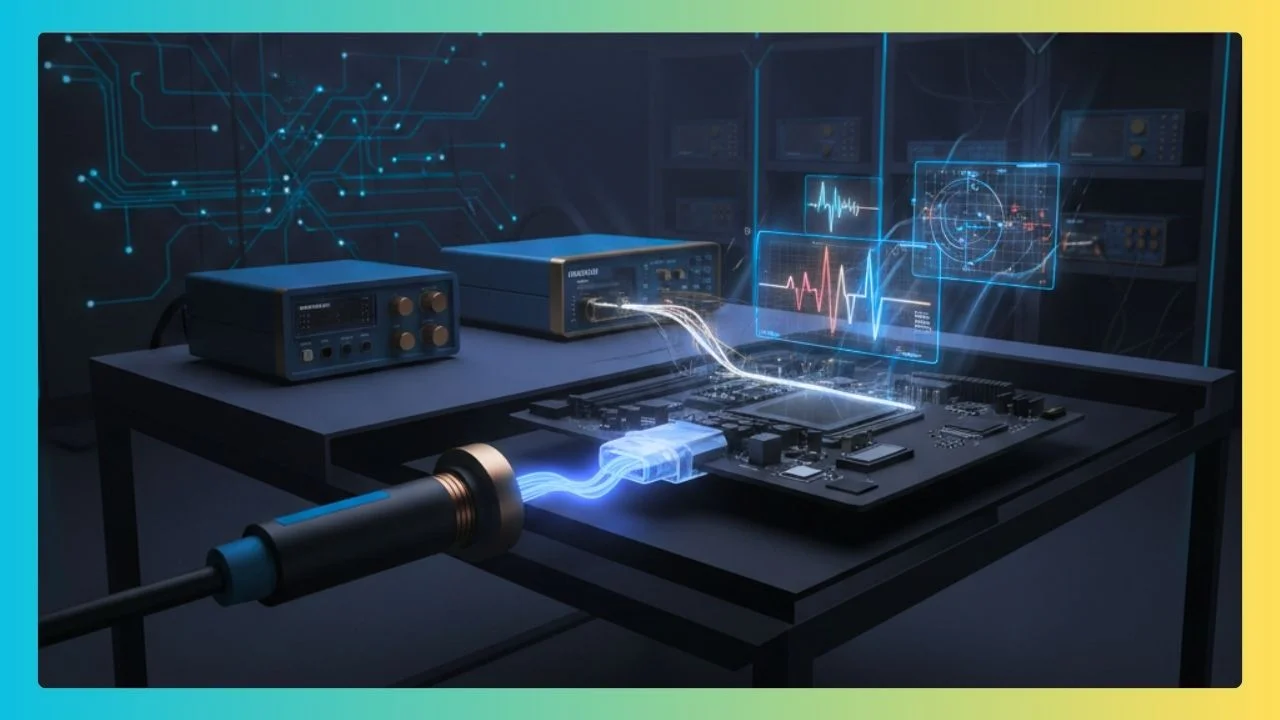
Teledyne LeCroy has introduced updated software for its QualiPHY 2 automated compliance testing platform, now supporting DisplayPort 2.1 physical layer (PHY) validation. This second-generation framework operates on the company’s oscilloscopes and targets high-speed serial interfaces like PCI Express, USB, Thunderbolt, DisplayPort, and HDMI. The new modules, QPHY2-DP2-SOURCE-TX for transmitter testing and QPHY2-DP2-SINK-RX for receiver testing, function either directly on oscilloscopes or offline via the QPHY2-PC option on a separate host machine.
DisplayPort 2.1 advances video transmission by combining ultra-high bit rates (UHBR) with multiple data lanes, enabling resolutions beyond 8K at high refresh rates. Such performance demands rigorous signal integrity checks to satisfy Video Electronics Standards Association (VESA) compliance test specifications (CTS). Even devices that clear these benchmarks frequently encounter interoperability issues in real-world source-sink pairings, leading to connection failures, reduced performance, or user dissatisfaction.
The QualiPHY 2 DisplayPort 2.1 solution streamlines testing across all UHBR, high bit rate (HBR), and reduced bit rate (RBR) modes. Engineers can automate source and sink evaluations within a unified environment, reducing manual intervention and test cycle times compared to first-generation tools.
Key elements include:
This integrated ecosystem addresses common bottlenecks in DisplayPort validation workflows. Traditional methods often require switching between instruments and software, extending debug sessions. QualiPHY 2 consolidates these steps, allowing teams to iterate faster on designs for graphics cards, monitors, docking stations, and adapters.
DisplayPort 2.1 emerges amid growing demands for high-fidelity visuals in professional settings. Enterprises increasingly deploy multi-monitor setups for data visualization, CAD modeling, video editing, and virtual collaboration. UHBR20, the standard’s top tier at 80 Gbps across four lanes, supports 16K at 60 Hz or 8K at 165 Hz with display stream compression (DSC), far exceeding DisplayPort 1.4 capabilities.
VESA’s CTS focuses on PHY-layer conformance, verifying eye height, jitter tolerance, and equalization presets. However, it omits end-to-end link negotiation, where PHY-Logic protocols—handling AUX channel handshakes and sideband messaging—prove critical. Mismatches here manifest as black screens, resolution downgrades, or USB-C alternate mode failures in Thunderbolt ecosystems.
Teledyne LeCroy’s tools bridge this gap by combining compliance automation with protocol-aware debugging. For instance, during sink testing, the MP1900A generates impaired signals mimicking cable losses or crosstalk, while WavePulser 40iX compensates via de-embedding models. This ensures devices not only pass CTS but perform reliably across cable lengths and connector types.
In data centers and edge computing, DisplayPort 2.1 PHY testing extends to virtual GPU passthrough and remote desktop protocols. Hyperscalers like those running NVIDIA Omniverse or AMD’s professional graphics stacks require validated interfaces to maintain low-latency rendering. Compliance gaps here can cascade into production delays, underscoring the value of efficient test flows.
Beyond CTS, Teledyne LeCroy emphasizes PHY-Logic analysis to preempt real-world failures. The VESA spec mandates AUX channel communication for link training, but subtle timing violations or malformed packets disrupt synchronization.
The debug setup leverages:
Engineers gain visibility into the full link-up sequence: from cable detection via sideband use (SBU) pins, through AUX discovery, to main link training. This holistic approach correlates electrical measurements with protocol states, accelerating root-cause analysis.
For example, a source device might pass transmitter CTS but fail to train a sink due to excessive low-frequency jitter on AUX. The oscilloscope’s simultaneous capture pinpoints this, with SDAX-DP quantifying its impact on eye opening.
QualiPHY 2’s offline mode via QPHY2-PC decouples analysis from hardware availability, enabling distributed teams to review captures asynchronously. Reports generate in standardized formats, easing regulatory submissions or vendor qualifications.
Test times shrink dramatically; previous workflows demanded hours per mode-fixture combination, now condensed to minutes. This efficiency scales for high-volume validation in fabs or ODM pipelines producing laptops, all-in-one PCs, and pro AV switchers.
Tyler Cox, vice president and general manager for scopes and digitizers at Teledyne LeCroy, noted that the platform addresses developers’ dual needs: rapid CTS adherence and tools to deliver seamless user experiences at UHBR rates.
Teledyne LeCroy’s update aligns with VESA’s push for broader DisplayPort 2.1 adoption, certified since October 2022. As UHBR clauses gain traction—seen in GPUs like AMD Radeon RX 7000 series and upcoming Intel Arc—the pressure mounts on test equipment vendors to match complexity.
Competitors like Keysight and Rohde & Schwarz offer similar PHY suites, but Teledyne’s emphasis on integrated PHY-Logic stands out for reducing escape defects. In cybersecurity-sensitive sectors, such as secure workstations, validated DisplayPort links prevent side-channel exploits via malformed AUX traffic.
Looking ahead, these tools position engineers for DisplayPort 2.1a extensions, potentially incorporating panel replay for OLEDs or enhanced HDR metadata. Sustained investment in automation will prove vital as bit rates climb toward 128 Gbps in future iterations.