
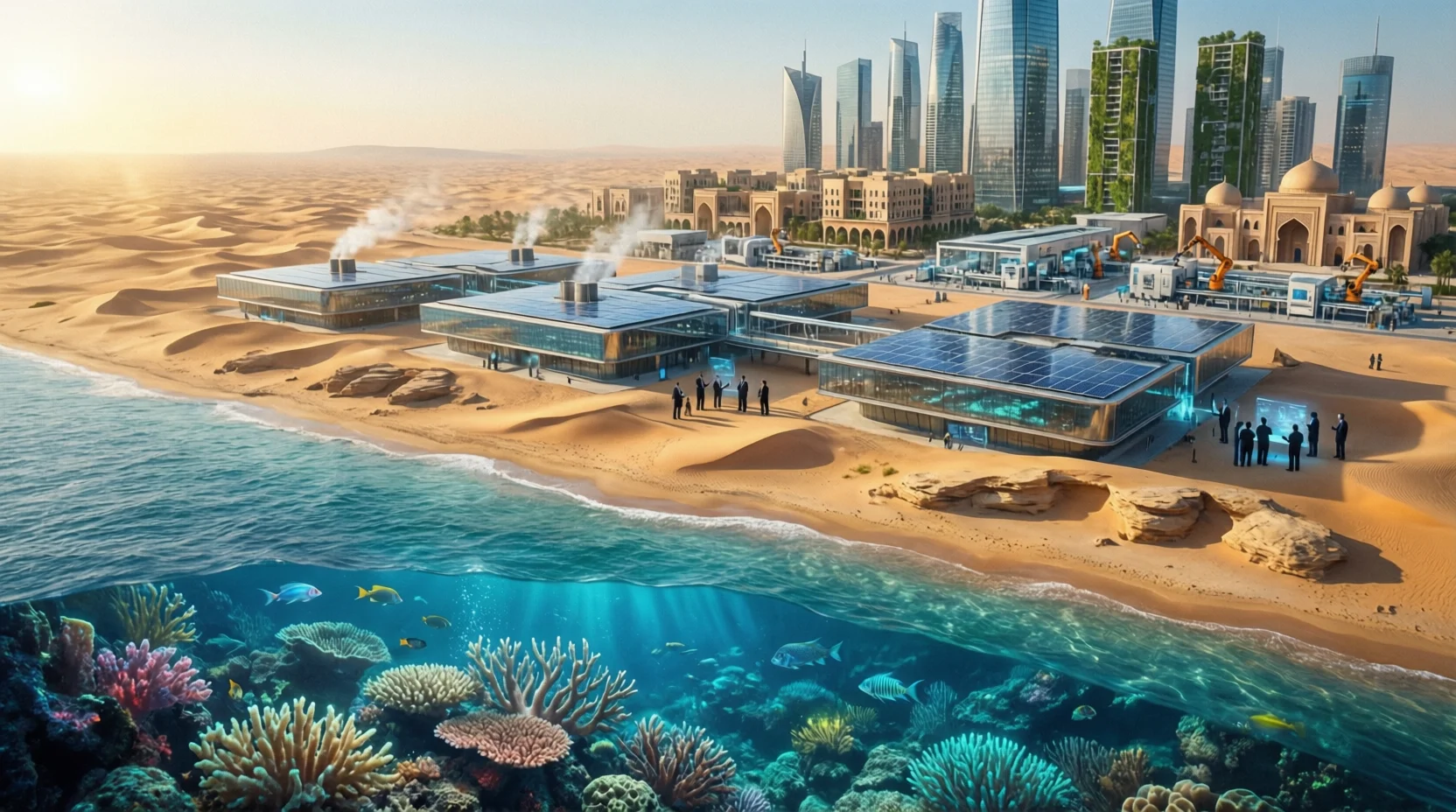
At the World Economic Forum’s Annual Meeting 2026, Saudi Arabia positioned itself as a convening power for critical global challenges spanning environmental conservation, artificial intelligence infrastructure, and industrial transformation. The Kingdom’s delegation announced several initiatives that signal a strategic pivot toward climate resilience and digital economy leadership while maintaining its Vision 2030 trajectory.
Her Royal Highness Ambassador Reema Bandar Al-Saud announced that Saudi Arabia will host the inaugural Global Coral Reef Summit in 2026, creating a platform where policymakers, scientists, and investors can collaborate on ecosystem protection strategies. The summit aims to identify regulatory gaps, develop evidence-based conservation methodologies, and establish sustainable financing mechanisms to scale reef recovery efforts globally.
Coral reefs face accelerating degradation from ocean warming and acidification, threatening marine biodiversity and coastal economies worldwide. By positioning itself as a convenor for this issue, Saudi Arabia is leveraging its geographic location along the Red Sea—home to some of the world’s most heat-resistant coral populations—as a strategic environmental asset.
HUMAIN and the National Infrastructure Fund formalized a Strategic Financing Framework Agreement valued at up to $1.2 billion to expand artificial intelligence and digital infrastructure projects across the Kingdom. The non-binding agreement establishes financing terms for developing up to 250 megawatts of hyperscale AI data center capacity.
His Excellency Abdullah A. Alswaha, Minister of Communications and Information Technology, highlighted the Kingdom’s economic diversification progress: “Saudi Vision 2030 was about economic diversification and empowering youth. Fast forward to today and we’ve achieved 56% non-oil contribution to GDP, and in terms of talent and youth, our tech force has increased dramatically.”
This infrastructure investment aligns with broader efforts to establish Saudi Arabia as a regional AI hub, supporting computational demands for machine learning workloads and cloud services while creating technical employment opportunities.
His Excellency Ahmed A. Alkhateeb, Minister of Tourism, framed tourism development as a peace-building mechanism: “Tourism brings peace at a time when it’s needed – connecting people and encouraging dialogue. Tourism growth is good for peace, it’s good for people, good for youth, and good for women.”
Meanwhile, the UNCCD COP16 Presidency launched the Business4Land Champions’ Council, a coalition uniting CEOs, sustainability executives, investors, and policymakers to accelerate land restoration and combat desertification. This initiative directly addresses drought resilience—a critical concern for arid regions experiencing climate volatility.
The Ministry of Industry and Mineral Resources, partnering with the World Economic Forum, introduced the Lighthouse Operating System—a national framework designed to accelerate manufacturing sector transformation. Developed with WEF’s Advanced Manufacturing and Production Centre, this program aims to diversify industrial capabilities beyond oil dependency and position Saudi Arabia within global advanced manufacturing value chains.
Additionally, MIM and WEF formalized a cooperation agreement extending through September 2027 to strengthen partnerships around critical minerals essential for energy technologies. A joint executive committee will oversee efforts to ensure resilient, sustainable mineral supplies aligned with industrial objectives and energy transition requirements.
These interconnected announcements demonstrate Saudi Arabia’s strategic approach to economic diversification: leveraging environmental stewardship, digital infrastructure investment, and industrial policy coordination as mechanisms for building international partnerships while transitioning toward a post-carbon economy.