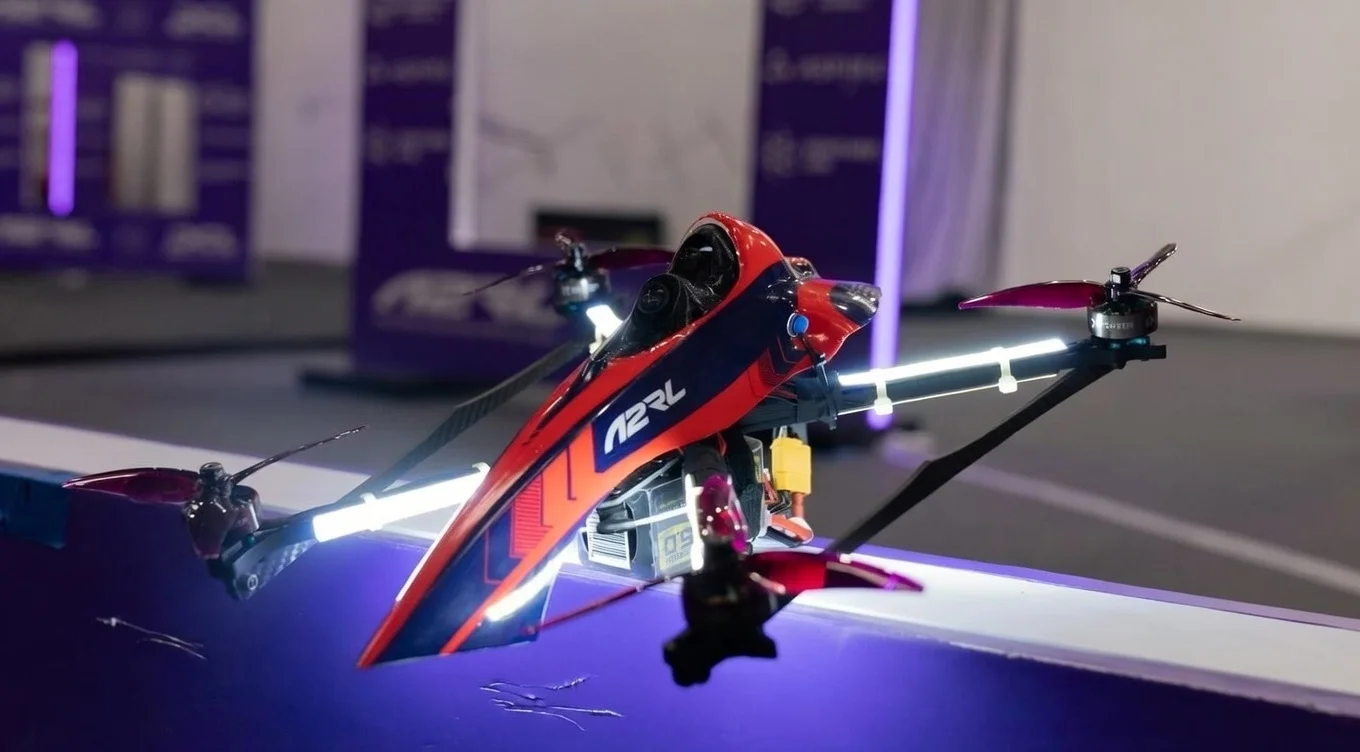
The gap between human intuition and artificial intelligence is narrowing at breakneck speed—literally. The Abu Dhabi Autonomous Racing League (A2RL) Drone Championship, held January 21–22 during UMEX, delivered empirical evidence of how rapidly vision-based autonomous systems are maturing under competitive pressure. Technology Innovation Institute’s TII Racing clocked the fastest autonomous lap in Championship history at 12.032 seconds, while world FPV champion MinChan Kim defeated his AI opponent by the slimmest of margins in a best-of-nine finale that went to the wire.
Organized by ASPIRE, the innovation arm of Abu Dhabi’s Advanced Technology Research Council (ATRC), the two-day event assembled leading AI research teams and elite first-person-view pilots to compete across multiple race formats. With USD 600,000 in total prize money distributed, the Championship functioned as both performance test and public benchmark for autonomous aerial systems operating under real-world constraints.
The AI Speed Race stripped away variables to isolate raw autonomous capability: perception accuracy, control precision, and maximum velocity on an unobstructed track. TII Racing’s 12.032-second lap represented the fastest performance recorded across all competitors, with MAVLAB following at 12.832 seconds. The tightening performance gap signals algorithmic progress rather than hardware advantage—all gains came from software refinement.
“What stands out this year is the collective progress across the field,” noted Stephane Timpano, CEO of ASPIRE. “Compared to Season 1, teams are achieving higher speeds with greater stability and consistency, driven almost entirely by software advances.”
Giovanni Pau, Technical Director at TII Racing, attributed the result to disciplined development methodology: “Achieving the fastest lap reflects the depth of our software development and testing. Performing at this level in a pure autonomy challenge shows what disciplined, vision-led systems can deliver when pushed to their limits.”
Beyond individual speed trials, the Multi-Drone Race formats tested coordination capabilities critical to real-world deployment: collision avoidance, trajectory planning, and operational resilience in dynamic environments. MAVLAB secured victory in the Multi-Drone Gold Race, demonstrating robust multi-agent planning under competitive conditions. FLYBY claimed first place in the Silver tier, underscoring growing depth across the Championship field.
These scenarios mirror challenges facing urban air mobility, emergency response drones, and logistics applications where multiple autonomous systems must operate safely in shared airspace without centralized control.
The Human vs AI Challenge delivered the Championship’s most dramatic moment. MinChan Kim and TII Racing’s autonomous system traded victories through eight races, entering the final run deadlocked at four wins each. Kim maintained his lead as the AI competitor struck a gate and failed to recover, securing human victory in a contest that exposed both the progress and remaining limitations of autonomous performance under extreme conditions.
Competition rules imposed strict technical parameters: all drones operated autonomously using only a forward-facing monocular RGB camera and inertial measurement unit. LiDAR, stereo vision, GPS, and external positioning systems were prohibited. This minimal sensor configuration mirrors human pilot perception while maintaining relevance to civilian autonomy constraints where cost, weight, and regulatory considerations limit sensor complexity.
The standardized approach ensures performance comparisons reflect software capability rather than hardware advantage, accelerating transferable insights for researchers developing systems under similar real-world constraints.
The Championship followed A2RL Summit 3.0, where policymakers and industry leaders examined pathways from competitive racing to commercial deployment. Discussions featuring senior leaders including Salem AlBalooshi, CTO of du, and Marcos Muller-Habig of Abu Dhabi Gaming addressed regulation frameworks, simulation-to-reality transfer, and scaling requirements across logistics, emergency services, and urban air mobility sectors.
As a public science testbed, A2RL compresses years of autonomous systems research into measurable performance benchmarks, reinforcing Abu Dhabi’s positioning as a proving ground for AI-driven innovation with direct applications beyond the racing circuit.