
Enterprise search is experiencing an identity crisis. The technology that powered e-commerce and SaaS navigation for two decades—keyword matching, filters, faceted navigation—suddenly feels inadequate when users expect conversational interfaces that understand intent, context, and nuance. At AI Day France 2026 on February 10, Algolia CTO Xavier Grand will address this tension directly in a presentation titled “Algolia & The GenAI UX Revolution: Merging Search and Conversation,” exploring how enterprises can bridge traditional search reliability with generative AI’s contextual capabilities.
The session, part of dotAI’s “The Tech Track” at Station F in Paris, places Grand alongside data science leaders from Mirakl and Upsun’s Field CTO Guillaume Moigneu in a multi-track format designed to showcase production AI systems built by France’s technology community. With 2,000 AI executives, researchers, and investors convening for the event’s 10th anniversary, the programming reflects an industry moving from experimental AI implementations to scaled deployment challenges.
For organizations managing customer-facing digital experiences, the pressure to integrate generative AI feels urgent—but the path forward is unclear. Replacing deterministic search with conversational interfaces introduces latency, unpredictability, and cost structures that don’t align with high-volume transaction environments. Yet maintaining purely traditional search feels increasingly disconnected from user expectations shaped by ChatGPT, Perplexity, and other conversational tools.
Algolia processes over 1.75 trillion queries annually across 18,000 businesses—a scale that makes experimentation expensive but provides unparalleled insight into real-world search behavior. Grand’s presentation will likely address how enterprises can layer conversational experiences atop proven search infrastructure rather than forcing an either-or choice between technologies that serve different user needs.
“At Algolia, we’re trusted by thousands of retailers and millions of developers around the world to equip them with fast, intuitive AI search solutions that build lasting customer loyalty and drive engagement and conversions,” said Grand. “In 2026, this means enterprise search strategy must be all-encompassing to include agentic, generative, and search experiences.”
Grand’s trajectory mirrors Algolia’s evolution from specialized search infrastructure to AI orchestration platform. Joining when the company had five employees, he helped scale operations through 750+ team members while maintaining the reliability and predictability that enterprise customers demand. This background positions him to address a question many AI Day attendees face: how do you productize cutting-edge AI research without sacrificing the performance guarantees that existing customers depend on?
The multi-track session format reinforces this practical orientation. Mirakl’s presentation on ad platform advancements and Upsun’s discussion of agent code readiness measurement suggest a shared theme—moving AI from proof-of-concept to production-grade systems that handle messy real-world data, scale constraints, and user behavior edge cases.
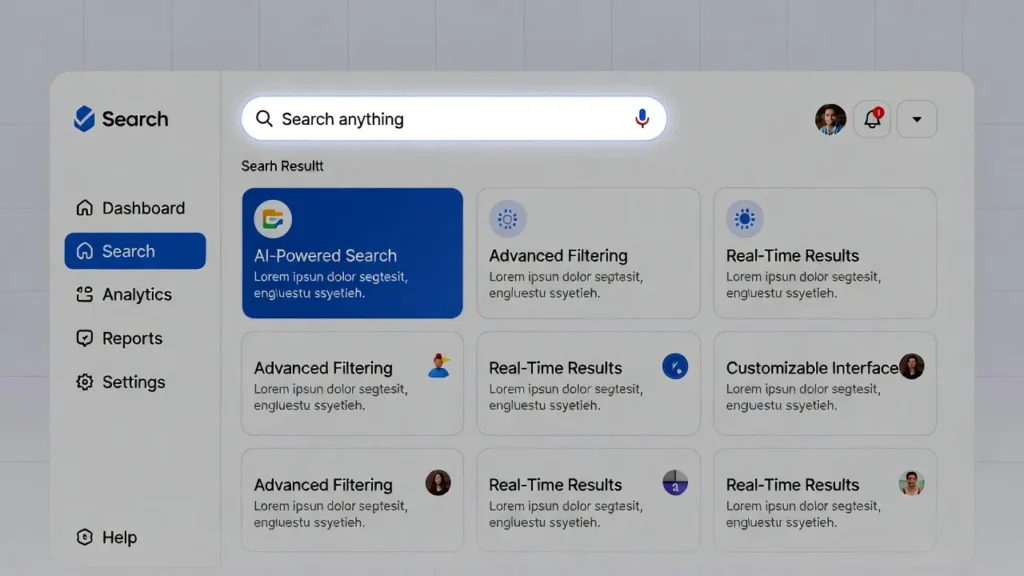
Grand’s framing—that enterprise search must now include agentic, generative, and traditional search experiences—raises architectural and organizational questions. Agentic systems make autonomous decisions across multi-step workflows. Generative interfaces synthesize information rather than retrieving documents. Traditional search returns ranked results users filter themselves. Each pattern suits different tasks, user contexts, and business objectives.
The challenge isn’t choosing which approach is “correct.” It’s building infrastructure flexible enough to route user interactions to the appropriate experience based on intent, query complexity, and downstream business logic. For retailers managing product catalogs, this might mean conversational browsing for discovery combined with traditional filters for specification-driven purchases. For SaaS platforms, it could involve agentic workflows for routine tasks with fallback to search when automation fails.
As enterprises navigate this transition, the practitioners building systems at trillion-query scale offer valuable perspective. Model benchmarks reveal capability; production deployment reveals what works when millions of users interact with imperfect data under real constraints. That gap between potential and practice is where February’s conversation becomes most relevant.
About Algolia
Algolia is the leading AI Search and Retrieval platform, powering 1.75 trillion searches a year for more than 18,000 businesses. With a unified keyword and vector search and retrieval engine, Algolia delivers the world’s fastest and most scalable search and discovery technology. Companies rely on Algolia to build agentic, generative, and search experiences through tools like Agent Studio. With over a decade of innovation, Algolia is redefining retrieval-powered applications and the future of AI discovery.