

While industry analysts debate Open RAN’s commercial viability, Airspan Networks is posting numbers that suggest the technology has moved past proof-of-concept. The wireless infrastructure provider closed 2025 with over $115 million in revenue—a 20% year-over-year increase—and entered 2026 with $70 million in backlog, positioning the company for projected revenue growth of 25-30% this year. These results arrive as Airspan completes two strategic acquisitions and relocates its corporate headquarters to Plano, Texas, signaling confidence in sustained demand across in-building networks, Open RAN deployments, and air-to-ground connectivity.
The financial trajectory reflects broader shifts in how telecom infrastructure gets deployed. Mobile operators are diversifying supplier bases to reduce vendor lock-in, private networks are proliferating across enterprise and defense applications, and in-building coverage demands are intensifying as 5G mid-band spectrum struggles to penetrate modern building materials. Airspan’s three business segments—In-Building, Open RAN, and Air-to-Ground—each address these dynamics from different angles.
Airspan’s 2025 acquisitions targeted both market access and technical capability. The purchase of Corning’s Wireless business brought digital distributed antenna system (Digital DAS) technology, in-building RAN solutions, and established relationships with Tier 1 mobile operators. This segment grew bookings by over 20% year-over-year, validating the thesis that in-building coverage gaps represent persistent revenue opportunities as buildings add density and spectrum moves to higher, less penetrative frequencies.
The second acquisition—Jabil’s radio portfolio, development team, and intellectual property—addresses a different strategic priority: domestic Open RAN development capacity. As governments prioritize supply chain security and national infrastructure resilience, US-based development capabilities carry competitive advantages beyond technical merit. Airspan reinforced this positioning by securing a $42.7 million NTIA grant to accelerate 5G Open RAN technology development domestically.
“We saw good momentum across all three businesses – In-Building, Open RAN, and Air-to-Ground – and delivered strong revenue growth and meaningful profitability,” said Glenn Laxdal, CEO of Airspan. “We have a firm financial foundation, and we are looking at opportunities to drive organic growth and explore strategic development efforts to consolidate Airspan’s position as the leading US based 5G vendor for critical infrastructure.”
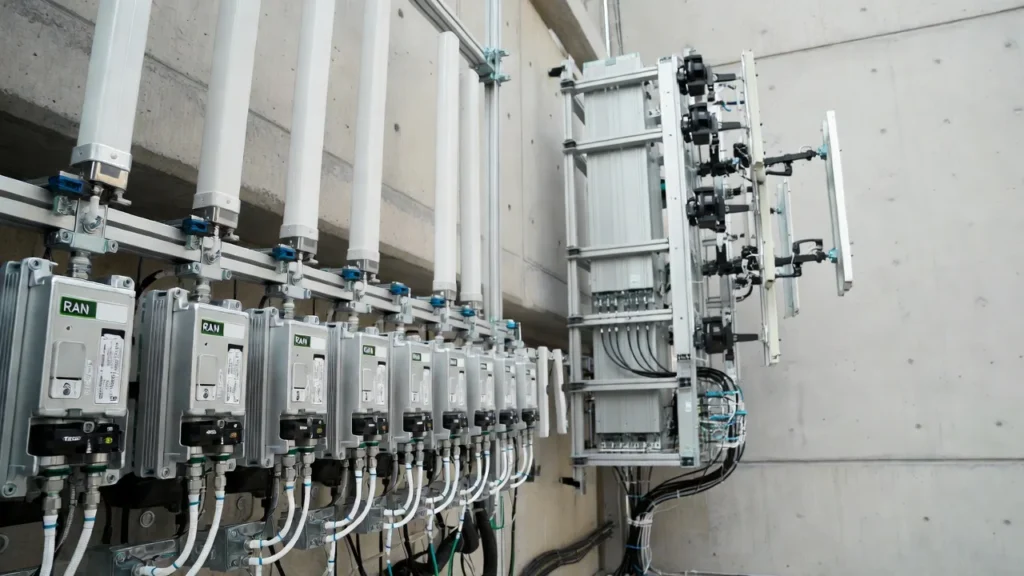
Airspan’s air-to-ground business illustrates how specialized connectivity applications are maturing into commercial deployments. The company enabled the commercial launch of what it describes as the world’s first 5G air-to-ground network with Gogo, addressing in-flight connectivity demands that legacy satellite and air-to-ground systems struggle to meet cost-effectively. The subsequent partnership with Space Compass for high-altitude platform systems targeting maritime surveillance extends this capability into defense and monitoring applications where terrestrial infrastructure doesn’t reach.
These projects share a common characteristic: they solve connectivity problems where traditional cellular deployment economics don’t work. In-building DAS addresses coverage where macro towers can’t penetrate. Open RAN provides supplier diversity where vendor lock-in creates strategic risk. Air-to-ground connectivity serves mobility scenarios terrestrial networks can’t follow. Each represents infrastructure gaps that persist despite billions in 5G capital expenditures.
The Rakuten Mobile deal carries particular strategic weight. As one of the world’s most prominent Open RAN deployments, Rakuten’s vendor selections influence industry perception of the technology’s readiness for Tier 1 operator networks. Airspan’s radio contract, with deployment starting in 2026, provides tangible validation beyond lab testing and limited trials.
Whether Open RAN achieves widespread operator adoption remains contested. Critics cite performance gaps, integration complexity, and unproven total cost of ownership. Proponents emphasize supplier diversity, interoperability benefits, and alignment with government infrastructure priorities. Airspan’s financial results—profitability, backlog growth, operator contracts—suggest the market has moved past purely speculative investment, even if the technology hasn’t yet displaced incumbent vendors at scale.
As the company prepares to showcase its portfolio at Mobile World Congress in Barcelona (March 2-5), the question isn’t whether Airspan can execute technically. The results demonstrate capability. The question is whether critical infrastructure budgets, private network deployments, and operator diversification strategies create addressable markets large enough to sustain 25-30% annual growth beyond 2026. The backlog suggests near-term confidence. Long-term trajectory depends on how quickly specialized applications become infrastructure defaults.
About Airspan
Headquartered in Plano, Texas, Airspan Networks Holdings LLC is an innovative US-based provider of wireless network solutions with a global presence, focused on delivering carrier-grade 5G and advanced wireless connectivity. Airspan’s portfolio spans three core solution areas – in-building, outdoor, and air-to-ground – and includes market-leading products for DAS, Open RAN, and small cells across both public and private network settings. Airspan supports mobile network operators, neutral-host providers, enterprises, public-sector organizations, and other service providers in building reliable, scalable wireless networks that enhance coverage and capacity while enabling fast, efficient deployment.