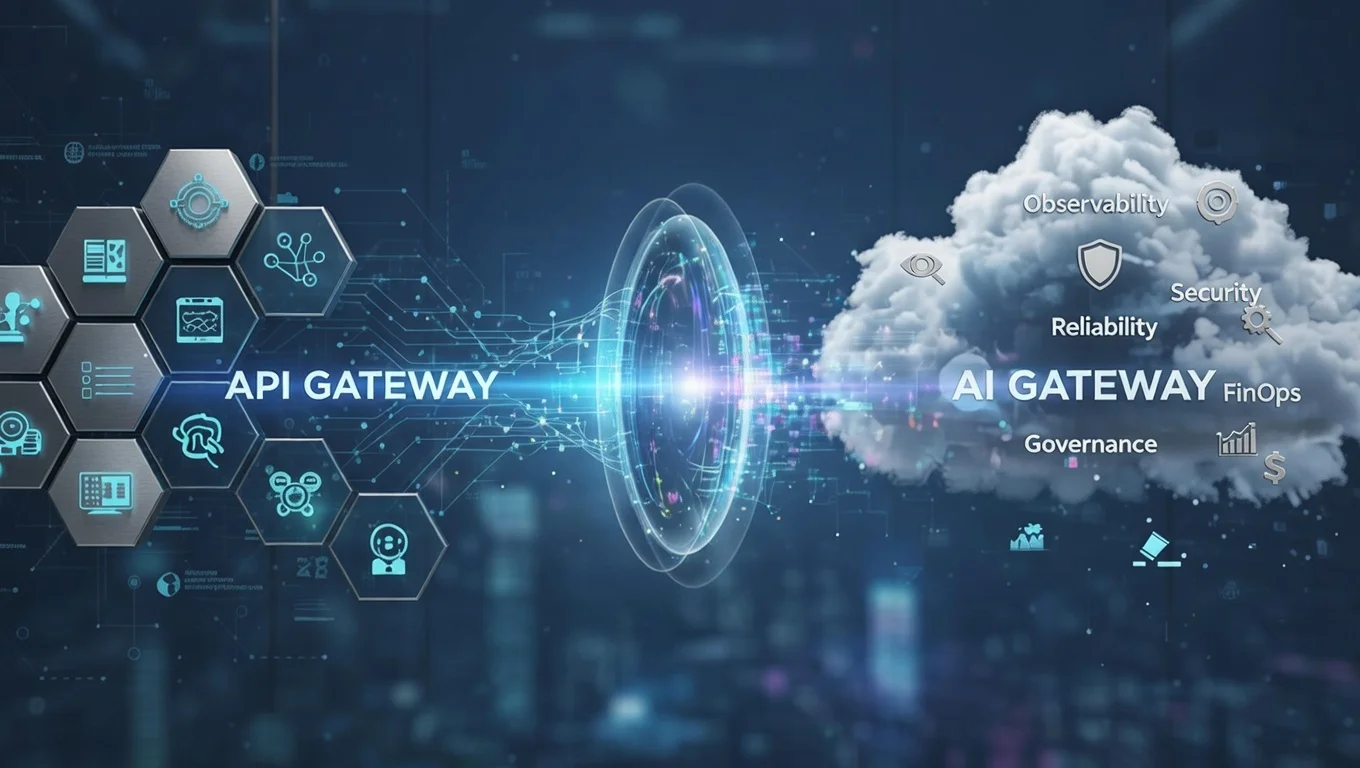
Building an AI model has never been easier. Scaling it reliably across an enterprise—with governance, cost controls, and operational visibility intact—remains one of the hardest unsolved challenges in modern technology leadership. As agentic AI moves from pilot projects to production deployments spanning thousands of endpoints, a critical infrastructure layer is emerging between applications and AI services: the AI gateway.
TrueFoundry has been named a Representative Vendor in the 2025 Gartner Market Guide for AI Gateways—an recognition that both validates the company’s early market positioning and signals how rapidly this infrastructure category is maturing. For enterprise technology leaders, this moment deserves closer examination.
The Gartner report carries a striking forecast: by 2028, 70% of software engineering teams building multimodal applications will use AI gateways to improve reliability and optimize costs. Consider the implication—within three years, AI gateways are projected to become as foundational to enterprise AI stacks as API management layers became to microservices architecture a decade ago. TrueFoundry’s early recognition positions it ahead of what promises to be significant market expansion.
TrueFoundry CEO Nikunj Bajaj articulates the enterprise challenge with precision: creating models is straightforward, but governance, control, and reliability don’t emerge automatically at scale. This is the architectural gap AI gateways are designed to close. TrueFoundry’s platform centralizes management of models, prompts, guardrails, MCP servers, and agents—providing the kind of unified control plane that enterprises running thousands of concurrent AI workloads genuinely require. Without it, organizations face fragmented observability, inconsistent compliance enforcement, and compounding operational risk.
Beyond analyst recognition, TrueFoundry’s operational scale speaks independently. Processing over 10 billion requests per month through its AI Gateway and managing more than 1,000 clusters via its Agentic Deployment platform establishes the company as a production-grade infrastructure provider—not an emerging challenger still proving viability. For Fortune 1000 enterprises evaluating vendors, this throughput represents meaningful evidence of reliability under enterprise demand conditions.
Traditional AI governance frameworks were designed for relatively static, single-model deployments. Agentic AI—where autonomous agents interact, delegate tasks, and operate across complex workflows—introduces governance complexity of an entirely different order. TrueFoundry’s vision of becoming the central control plane for enterprise agentic AI reflects an understanding that the infrastructure requirements of agent orchestration fundamentally differ from those of conventional machine learning pipelines.
The formalization of AI gateways as a distinct Gartner-recognized category confirms what forward-thinking CTOs have been experiencing operationally: the infrastructure layer between enterprise applications and AI services is becoming a critical investment priority, not an optional enhancement.
For technology and operations leaders navigating this shift, three strategic actions warrant immediate consideration:
The organizations that treat AI gateway infrastructure as a foundational investment in 2026 will be measurably better positioned when the Gartner forecast materializes in 2028.
TrueFoundry’s inclusion in the Gartner Market Guide for AI Gateways marks more than a vendor milestone—it marks the maturation of a category that will underpin enterprise AI reliability for years to come. As agentic applications proliferate and governance demands intensify, the question for technology leaders is no longer whether to invest in AI gateway infrastructure, but how quickly they can make that investment count.
How is your organization currently managing governance and observability across multi-agent AI deployments? Share your perspective in the comments.
About TrueFoundry
TrueFoundry is an Enterprise Platform as a Service that enables companies to build, observe, and govern Agentic AI applications securely, scalably, and with reliability through its AI Gateway and Agentic Deployment platform. Leading Fortune 1000 companies trust TrueFoundry to accelerate innovation and deliver AI at scale, with over 10 billion requests per month processed via the TrueFoundry AI Gateway and more than 1,000 clusters managed by its Agentic deployment platform. TrueFoundry’s vision is to become the central control plane for running Agentic AI at scale within enterprises, serving as the command center for enterprise AI. Headquartered in San Francisco, TrueFoundry operates across North America, Europe, and Asia-Pacific, supporting enterprise AI deployments for some of the world’s most innovative organizations. To learn more about TrueFoundry, visit truefoundry.com.