
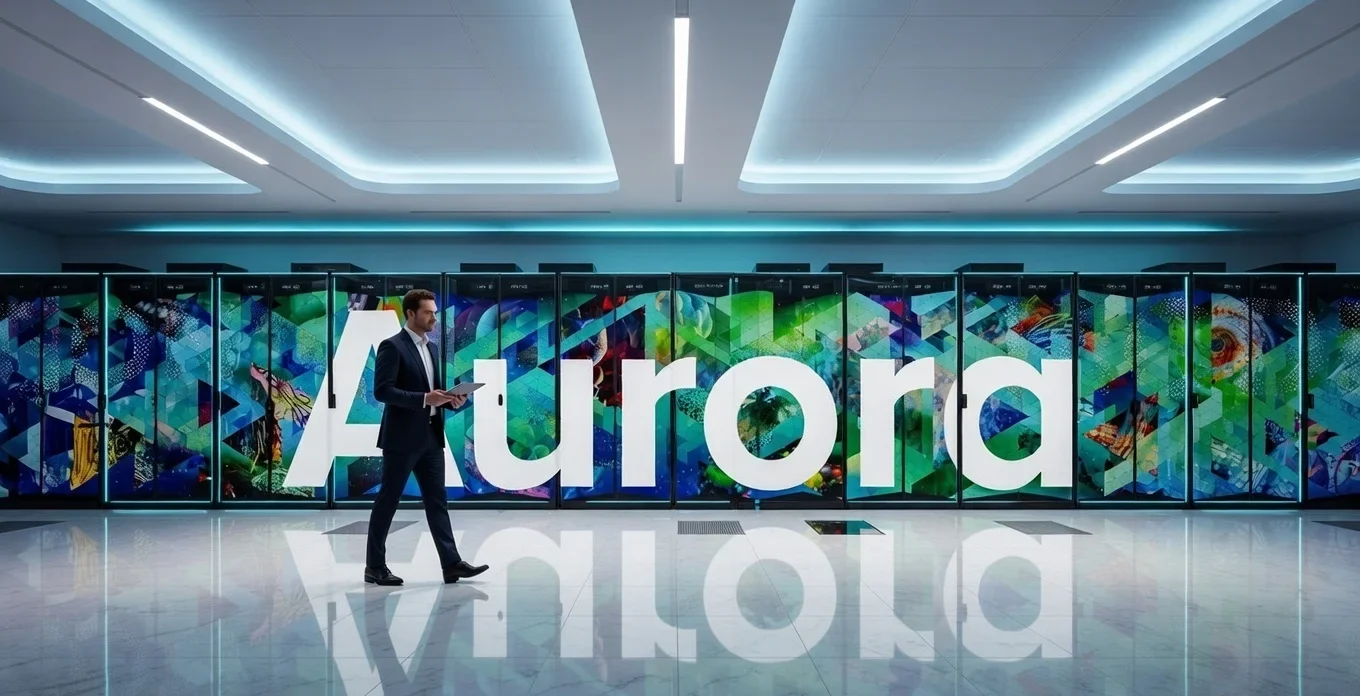
How can we harness the energy of a star on Earth? The U.S. Department of Energy’s (DOE) Argonne National Laboratory is making significant strides with the Aurora supercomputer, one of the world’s fastest machines. Aurora, housed at the Argonne Leadership Computing Facility (ALCF), is a critical tool in solving the grand scientific challenge of fusion energy.
The Aurora supercomputer, capable of performing a quintillion calculations per second, is revolutionizing fusion research. “Even just regular fluids are a very complicated scientific problem. When they become turbulent, it’s very chaotic,” said Kyle Felker, an assistant computational scientist at Argonne. “In tokamaks, we’re complicating this by adding magnetic fields and extreme conditions that don’t occur anywhere on Earth.” This announcement marks a significant leap forward in the quest for sustainable energy.
Fusion energy holds the promise of solving our growing energy needs with a nearly limitless and clean source. However, the primary hurdle is creating and maintaining a stable environment for the fusion reaction. Tokamaks, doughnut-shaped machines, use magnetic fields to confine plasma, but the complexity of these conditions has been a significant barrier. The fragility of the fusion reaction, which can be easily extinguished, requires precise control and understanding.
Just as a master chess player anticipates multiple moves ahead, Aurora enables scientists to simulate and predict the intricate dynamics of fusion reactions. By harnessing exascale computing, researchers can model the turbulent behavior of plasma and magnetic fields with unprecedented accuracy. This capability is crucial for developing commercially viable fusion power plants, which need reliable and tunable resources.
Aurora is at the forefront of fusion research, providing the computational muscle needed to simulate conditions inside tokamaks. The supercomputer’s exascale power allows for the detailed modeling of plasma flow and energy, which is essential for understanding and controlling fusion reactions. “We have lots and lots of data from historical campaigns. So we can take AI to learn what we can about these instabilities and hopefully avoid them entirely,” said William Tang, a scientist at the Princeton Plasma Physics Laboratory (PPPL).
The journey to practical fusion energy is far from over, but exascale computing and AI are bringing us closer than ever. Just as a lighthouse guides ships through treacherous waters, Aurora illuminates the path to a sustainable energy future. The next milestones include refining AI models and expanding the scope of simulations to address new challenges. The DOE and its partners are committed to advancing this critical research, with the goal of making fusion energy a reality.
This breakthrough in computational power and AI-driven research marks a significant step toward solving the world’s energy crisis. For industries and governments investing in sustainable energy, the implications are profound. How is your organization preparing for the shift to fusion energy? Join the conversation in the comments below.
Source link: https://www.businesswire.com/