
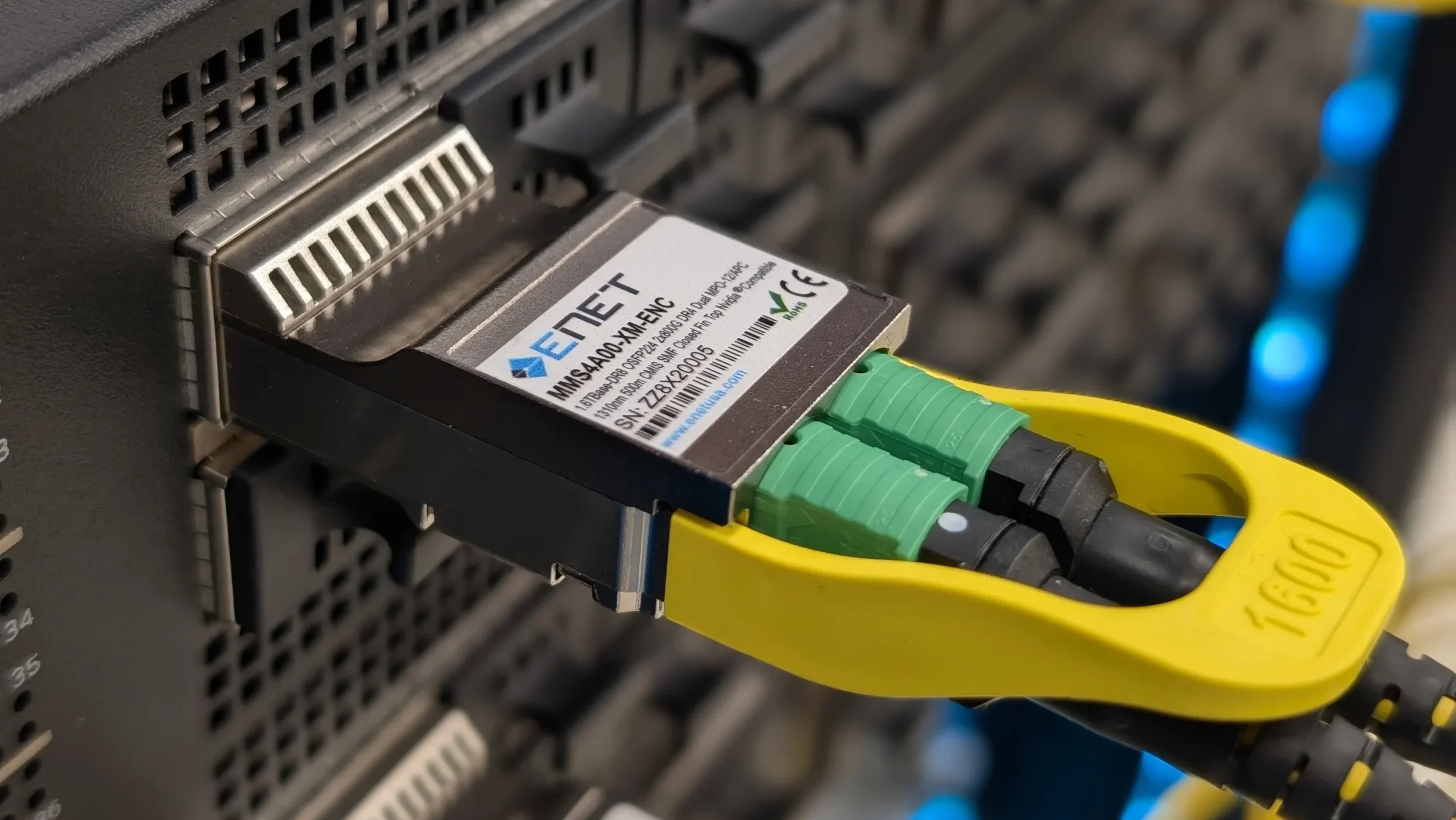
ENET, a member of the Network Infrastructure division of NSI Industries, today introduced its 1.6T DR8 OSFP224 optical transceiver designed for next-generation AI, high-performance computing, and hyperscale data center environments. The solution leverages 224G electrical signaling to deliver 1.6 terabits per second of total throughput over eight 200G PAM4 electrical lanes. Built for high-density switching and GPU-driven AI clusters, the transceiver supports scalable interconnects for spine, leaf, and accelerator topologies while maintaining signal integrity and low error rates over parallel single-mode fiber.
The OSFP224 form factor positions ENET’s latest offering at the forefront of data center connectivity, keeping pace with evolving switch and accelerator technologies supporting 200G per lambda interfaces. As AI models grow in complexity and cluster sizes expand, data center operators face increasing demands for higher switch capacities, denser port counts, and improved power efficiency. The 1.6T DR8 OSFP224 addresses these requirements directly.
The 1.6T DR8 OSFP224 represents a significant advancement in optical transceiver technology, specifically engineered for the unique demands of AI and HPC environments. By implementing 224G electrical signaling across eight 200G PAM4 lanes, the module achieves the bandwidth density required for modern GPU interconnects and advanced switching fabrics. This approach enables data center architects to design spine-leaf and accelerator topologies that minimize latency while maximizing throughput for distributed AI training workloads. The parallel single-mode fiber interface ensures signal integrity over the distances typical in hyperscale data center deployments.
As AI models scale to trillions of parameters, the network infrastructure connecting thousands of GPUs becomes a critical performance bottleneck. “As AI models grow larger and clusters become more complex, networks need to offer consistent, high-speed performance,” said Jason Barrette, VP of Sales and Operations at ENET. “Our 1.6T DR8 OSFP224 is designed for demanding GPU interconnects and advanced switching environments, where bandwidth, density, and reliability are crucial for maximizing computing power.” The transceiver’s support for both InfiniBand and Ethernet protocols ensures compatibility with leading AI fabric architectures, giving data center operators flexibility in their infrastructure choices.
Beyond raw performance specifications, the 1.6T DR8 OSFP224 incorporates comprehensive monitoring capabilities through built-in digital diagnostics compliant with CMIS 5.3. Network operators can track optical power levels, temperature variations, voltage stability, and other critical performance metrics in real time. This visibility enables proactive management of large-scale networks, allowing administrators to identify potential issues before they impact application performance. For hyperscale operators managing thousands of transceivers across global data center footprints, these diagnostic features translate directly to improved reliability and reduced mean time to resolution.
ENET’s introduction of 1.6T OSFP224 transceivers arrives as the industry approaches a inflection point in AI infrastructure scaling. With GPU cluster sizes expanding rapidly and switch silicon pushing toward higher port densities, optical connectivity must keep pace to avoid becoming the limiting factor in system performance. The 224G electrical signaling foundation positions this transceiver generation to support multiple product cycles as switch application-specific integrated circuits evolve. Data center operators qualifying the 1.6T DR8 OSFP224 today gain a pathway to higher bandwidth while maintaining infrastructure consistency. The availability of real-time diagnostics through CMIS 5.3 also supports the automation and telemetry requirements increasingly standard in large-scale AI factories.
ENET’s 1.6T DR8 OSFP224 optical transceiver delivers the bandwidth density, signal integrity, and protocol flexibility required for next-generation AI and HPC environments. By combining 224G electrical signaling with comprehensive digital diagnostics, the solution addresses both current performance demands and future scalability requirements. Data center operators seeking to maximize GPU cluster utilization now have access to transceiver technology engineered specifically for high-density, high-reliability AI fabrics.
Join the conversation in the comments below.
About ENET
ENET manufactures and distributes network peripheral devices. Our product portfolio consists of OEM Equivalent and customized Optical Transceivers, Fiber, Copper, and OEM Compatible Cables and Fiber Media Converters. Our support team works alongside our customers to provide guidance in the pre and post sales process by providing technical information pertinent to their specific network environment. ENET enables our customers to achieve their overall business objectives including maximizing IT budgets, increased product availability, shorter lead times, and superior customer support.
Source link: https://www.businesswire.com/