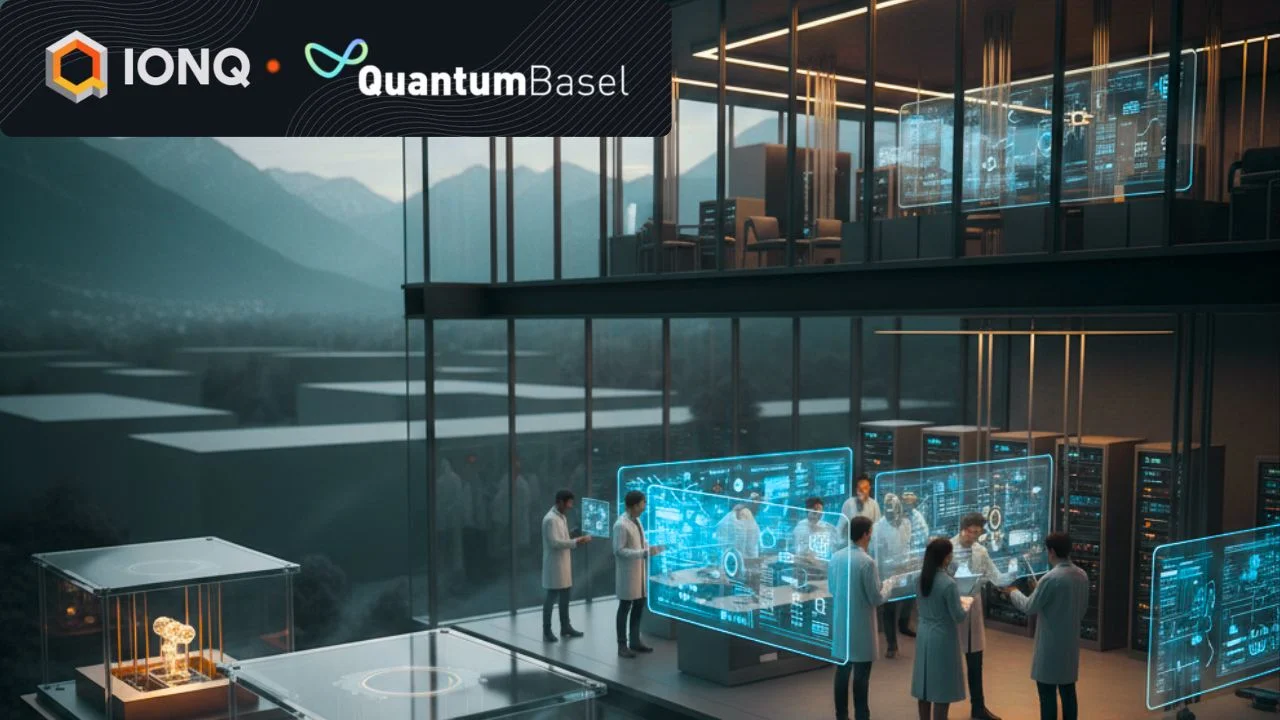
IonQ, a prominent player in quantum computing, has broadened its collaboration with QuantumBasel, an initiative based at Switzerland’s uptownBasel innovation campus. The updated agreement transfers ownership of QuantumBasel’s current IonQ Forte Enterprise system to the organization and provides access to IonQ’s forthcoming Tempo system. This move extends IonQ’s physical presence in Switzerland until 2029 and elevates the partnership’s total value beyond $60 million.
QuantumBasel operates as IonQ’s designated Innovation Center in Europe. It functions as a central resource for businesses, universities, and research groups across the continent to test quantum applications using IonQ’s enterprise hardware. The expansion underscores IonQ’s efforts to embed quantum capabilities within Europe’s technology landscape.
The renewed contract solidifies QuantumBasel’s position as a key outpost for IonQ’s international operations. Niccolo de Masi, IonQ’s Chairman and CEO, highlighted the site’s role in fostering a quantum ecosystem tailored to European needs. He pointed to potential advancements in fields like materials science, defense technologies, artificial intelligence, life sciences, and logistics.
This partnership aligns with broader industry shifts toward practical quantum integration. Quantum systems remain noisy and error-prone, but progress in error correction and hybrid approaches promises nearer-term utility. IonQ’s strategy emphasizes scalable hardware that enterprises can access without building their own infrastructure.
IonQ plans to increase its on-site staff in Basel, bolstering both hardware maintenance and joint research projects. This includes dedicated teams for system optimization and collaborative experiments. Such investments aim to lower barriers for European organizations exploring quantum advantages over classical computing.
QuantumBasel’s existing setup relies on the IonQ Forte Enterprise, a trapped-ion system known for its stability and #AQ 36 algorithmic qubits—a benchmark for computational power. The incoming Tempo represents the next phase in IonQ’s development roadmap. Expected to handle more complex quantum circuits with improved fidelity, Tempo targets fault-tolerant operations essential for real-world workloads.
These upgrades enable deeper explorations in quantum volume, a metric gauging a system’s ability to execute useful computations. For context, IonQ’s systems use ytterbium ions suspended in electromagnetic fields, allowing precise laser-based control. Tempo’s enhancements could support simulations unattainable on classical supercomputers, such as molecular modeling for pharmaceuticals or portfolio optimization in finance.
The agreement spans four generations of IonQ hardware, signaling long-term commitment. This phased approach lets QuantumBasel users iterate on applications as fidelity improves, from proof-of-concept demos to production-scale deployments.
Beyond hardware, the partners are ramping up joint research. New projects target large language models (LLMs) and hybrid quantum-classical algorithms. Researchers aim to leverage quantum processors for tasks like variational quantum eigensolvers, which could refine AI training by accelerating parameter optimization.
Hybrid techniques blend quantum circuits with classical GPUs, addressing current limitations in qubit count and coherence times. Early results might enhance LLM efficiency, such as reducing energy demands in inference or improving accuracy in generative tasks. These efforts prioritize commercial viability, focusing on sectors where quantum edges emerge soonest—like supply chain resilience or drug discovery.
Thomas Landolt, QuantumBasel’s CEO, emphasized the on-site system’s role in nurturing a local community. UptownBasel hosts events, workshops, and residencies that draw participants from industry and academia, accelerating knowledge transfer.
This deal builds on IonQ’s accelerating footprint in Europe. In December 2024, the company activated its first European quantum computer at uptownBasel, marking a milestone in regional accessibility.
Recent moves include a collaboration with CCRM Nordic on quantum biotech applications, potentially streamlining genomic analysis and protein folding. Partnerships extend to Sweden’s Einride, applying quantum methods to logistics and autonomous trucking optimization.
Acquisitions have fortified IonQ’s capabilities: Oxford Ionics brings expertise in scalable ion traps from the UK, while ID Quantique, a Swiss firm, adds quantum networking and secure communications. Additionally, IonQ established IonQ Italia under Dr. Marco Pistoia, targeting Italy’s financial and manufacturing sectors.
These initiatives reflect Europe’s growing quantum ambitions, backed by initiatives like the EuroHPC Joint Undertaking and national funding programs. IonQ positions itself as a bridge between U.S. innovation and European deployment needs.
The QuantumBasel expansion addresses a core challenge in quantum adoption: availability of production-ready systems. Enterprises often hesitate due to high costs and technical complexity, but shared facilities like this lower entry points. Users gain remote access via cloud interfaces, enabling experimentation without capital outlays.
In finance, quantum algorithms could model risk scenarios with unprecedented granularity. Materials science benefits from simulating atomic interactions, aiding battery or alloy development. Life sciences stand to gain from faster virtual screening of compounds, compressing drug development timelines.
However, commercialization hinges on reliability. Current noisy intermediate-scale quantum (NISQ) devices suit narrow tasks, but fault tolerance—targeted by Tempo—unlocks broader utility. IonQ’s roadmap anticipates #AQ scores exceeding 64 soon, a threshold for many hybrid applications.
Challenges persist, including cryogenic requirements and integration with existing IT stacks. Partnerships like this mitigate them by pooling resources. As Europe builds its quantum sovereignty, sites like QuantumBasel could catalyze clusters akin to Silicon Valley’s early days.
Regulators also factor in. The EU’s Quantum Flagship program emphasizes ethical AI-quantum intersections, prompting research into secure multiparty computation. IonQ’s ID Quantique integration bolsters quantum key distribution, vital for data-sensitive industries.
IonQ’s moves occur amid fierce competition. Rivals like IBM, Google, and Rigetti pursue similar hybrid strategies, while startups focus on specialized niches. Trapped-ion tech, IonQ’s forte, excels in fidelity but lags photonic or superconducting approaches in qubit scaling.
Europe’s quantum scene thrives, with over 200 startups and €7 billion in public investments since 2018. Switzerland’s neutrality and infrastructure make Basel ideal for cross-border work. This partnership could draw talent and funding, positioning uptownBasel as a nexus.
About QuantumBasel
QuantumBasel is a competence center for quantum computing and AI and drives access to commercial quantum computing to foster innovation. QuantumBasel places particular emphasis on technological neutrality and is Switzerland’s first commercial quantum computing hub, providing access to hardware from IBM, D-Wave and IonQ. QuantumBasel’s team of quantum and data scientists trains and supports companies, conducts projects in quantum computing and AI, and collaborates closely with universities and academic institutions. Through an internationally connected ecosystem, QuantumBasel provides access to advanced know-how and technologies, enabling companies in industrial production, logistics, finance, energy, life sciences, and start-ups to achieve innovations they cannot develop independently. www.quantumbasel.com.
About IonQ
IonQ, Inc. [NYSE: IONQ] is the world’s leading quantum company delivering solutions to solve the world’s most complex problems. IonQ’s newest generation of quantum computers, IonQ Forte and IonQ Forte Enterprise, are the latest in a line of cutting-edge systems that have been helping customers and partners such as Amazon Web Services, AstraZeneca, and NVIDIA achieve 20x performance results. The company achieved 99.99% two-qubit gate fidelity, setting a world record in quantum computing performance in 2025.
The company is accelerating its technology roadmap and intends to deliver the world’s most powerful quantum computers with 2 million qubits by 2030 to accelerate innovation in drug discovery, materials science, financial modeling, logistics, cybersecurity, and defense. IonQ’s advancements in quantum networking position the company as a leader in building the quantum internet.
IonQ has operations in Maryland, Washington, California, Colorado, Massachusetts, Tennessee, United Kingdom, Toronto, Italy, South Korea, Sweden, and Switzerland. The company’s innovative technology and rapid growth were recognized in Fortune Future 50, Newsweek’s 2025 Excellence Index 1000, and Forbes’ 2025 Most Successful Mid-Cap Companies list. Available through all major cloud providers, IonQ is making quantum more accessible and impactful than ever before. Learn more at IonQ.com.