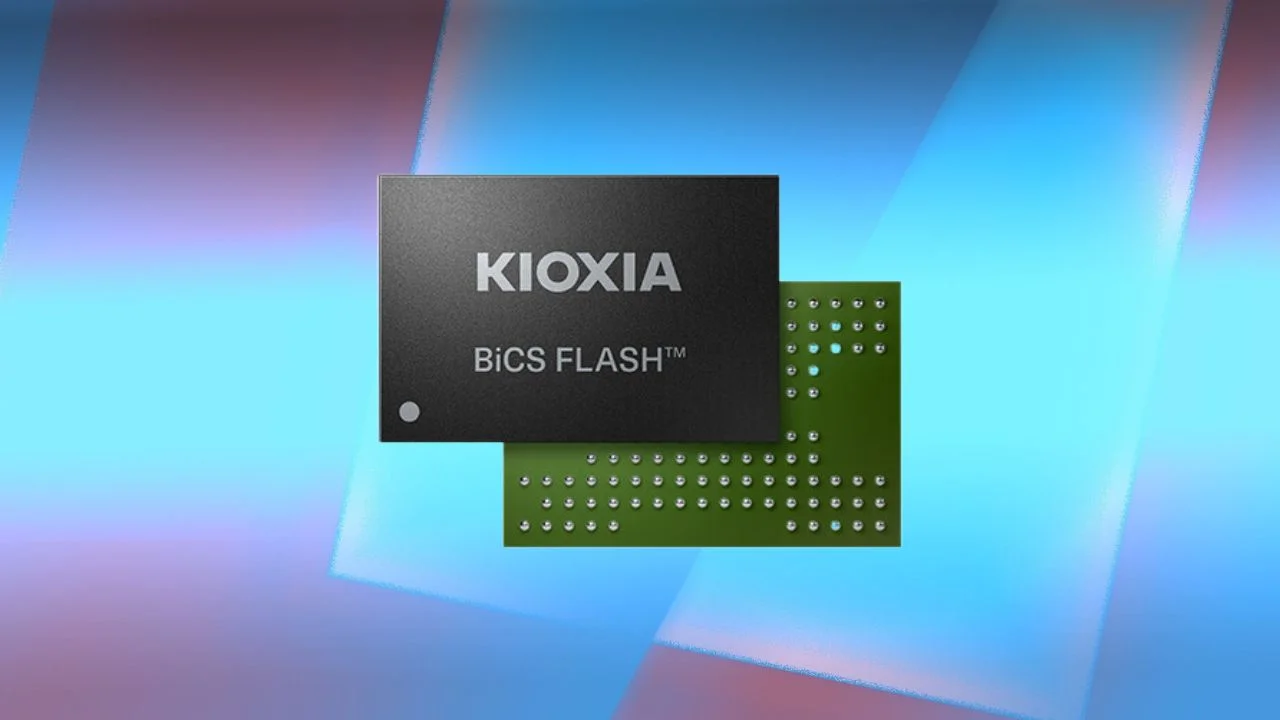
Kioxia Corporation, a global leader in memory solutions, has announced the commencement of sample shipments for its latest 512Gb Triple-Level Cell (TLC) memory devices, powered by the company’s cutting-edge 9th generation BiCS FLASH™ 3D flash memory technology. The company plans to transition to mass production of these devices in fiscal year 2025, targeting applications that demand high performance and exceptional power efficiency, particularly in low- to mid-level storage capacities. These advanced memory solutions will also be integrated into Kioxia’s enterprise SSDs, with a focus on enhancing GPU efficiency in AI-driven systems.
Kioxia’s approach to innovation is guided by a dual-axis strategy designed to meet the diverse needs of modern applications while maximizing investment efficiency. This strategy encompasses two key product lines:
The new 9th generation BiCS FLASH™ 512Gb TLC devices are built using a 120-layer stacking process derived from Kioxia’s 5th generation BiCS FLASH™ technology, enhanced with advanced CMOS technology. Compared to Kioxia’s existing 6th generation BiCS FLASH™ products with the same 512Gb capacity, the new devices demonstrate significant performance improvements, including:
Additionally, Kioxia has demonstrated that the 512Gb TLC devices can operate at NAND interface speeds of up to 4.8Gb/s under specific test conditions. The final product lineup will be tailored to align with market demands.
Kioxia remains steadfast in its mission to strengthen global partnerships and drive further innovation. By leveraging its expertise in memory solutions, the company aims to deliver products that address the evolving needs of its customers across various industries. These sample shipments represent a critical step in validating the functionality of the new devices, with the understanding that specifications may differ once mass production begins.
The 9th generation BiCS FLASH™ devices benefit from CBA (CMOS directly Bonded to Array) technology, a process where CMOS wafers and cell array wafers are manufactured separately under optimized conditions before being bonded together. This approach allows Kioxia to integrate proven memory cell technologies—such as its 112-layer 5th generation BiCS FLASH™ and 218-layer 8th generation BiCS FLASH™ technologies—with state-of-the-art CMOS advancements. The result is a product that maximizes performance while maintaining cost efficiency.
The 512Gb TLC devices are designed to support a wide range of applications, from consumer electronics to enterprise-grade solutions. Their high performance and power efficiency make them ideal for use in AI systems, where GPU efficiency is paramount. Additionally, their scalability ensures they can meet the demands of both low- and mid-level storage requirements, making them versatile tools for developers and enterprises alike.
It is important to note that the product density of Kioxia’s memory solutions is based on the density of the memory chips within the device, not the amount of memory available for data storage by end users. Consumer-usable capacity will typically be lower due to factors such as overhead data areas, formatting, bad blocks, and other constraints. Furthermore, read and write speeds mentioned in this announcement represent the best values obtained under specific test conditions and may vary depending on the host device and application.
About Kioxia
Kioxia is a world leader in memory solutions, dedicated to the development, production and sale of flash memory and solid-state drives (SSDs). In April 2017, its predecessor Toshiba Memory was spun off from Toshiba Corporation, the company that invented NAND flash memory in 1987. Kioxia is committed to uplifting the world with “memory” by offering products, services and systems that create choice for customers and memory-based value for society. Kioxia’s innovative 3D flash memory technology, BiCS FLASH™, is shaping the future of storage in high-density applications, including advanced smartphones, PCs, automotive systems, data centers and generative AI systems.