The mobile device ecosystem faces a fundamental constraint: as applications grow more sophisticated and data-intensive, traditional storage architectures struggle to deliver the capacity users demand without sacrificing performance or device form factor. Content creators shooting 4K video, professionals running resource-intensive applications, and consumers managing expanding media libraries have all bumped against the limits of conventional embedded flash memory. The industry needed a solution that could scale capacity without compromising the compact footprints mobile devices require.
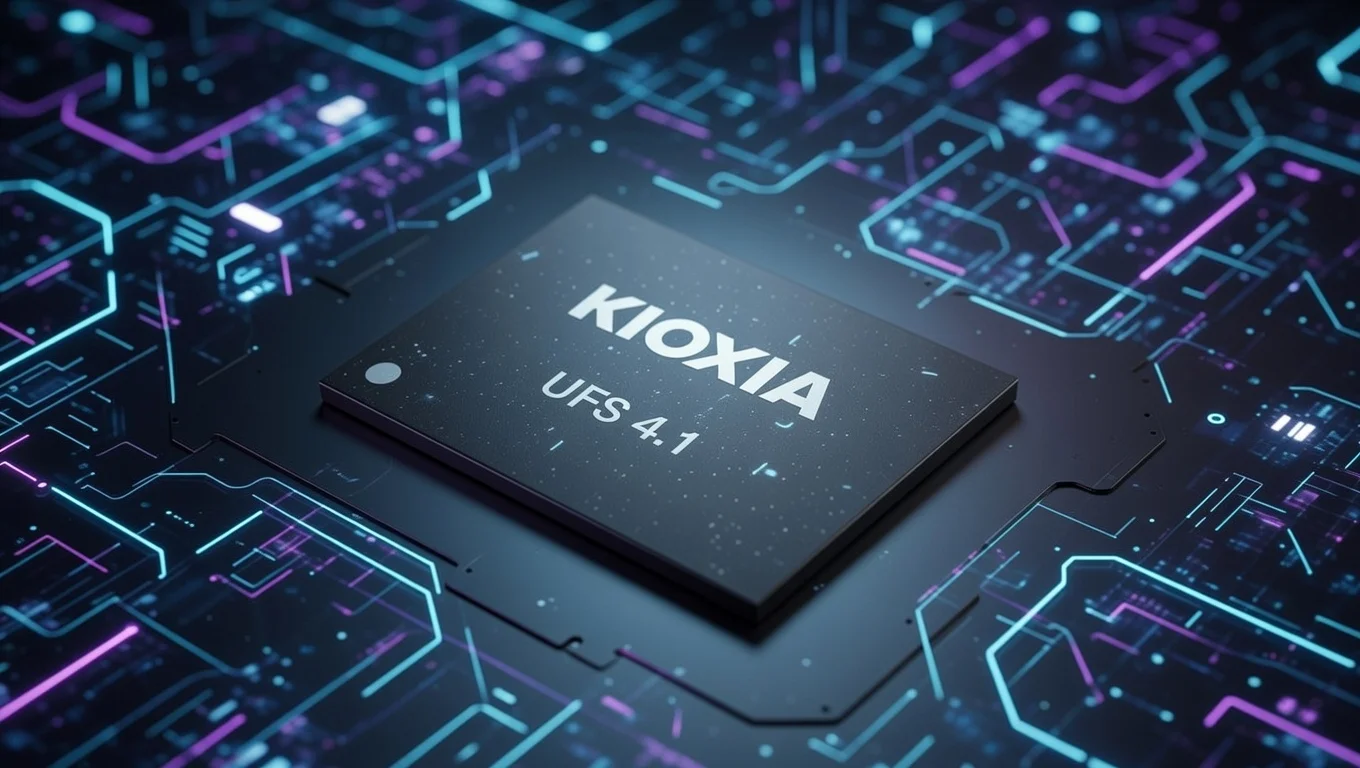
Kioxia Corporation has begun sampling Universal Flash Storage (UFS) Ver. 4.1 embedded memory devices that leverage quadruple-level cell (QLC) technology—a 4-bit-per-cell architecture that significantly increases bit density compared to triple-level cell (TLC) alternatives. These devices are built on Kioxia’s 8th generation BiCS FLASH 3D flash memory, which introduces CMOS directly Bonded to Array (CBA) technology, representing what the company describes as a fundamental architectural shift in flash memory design.
The performance metrics demonstrate meaningful advances over the previous generation UFS 4.0 devices utilizing BiCS FLASH 6 QLC technology. Sequential write speeds improve by 25 percent, while random read operations accelerate by 90 percent and random write operations by 95 percent. Perhaps most significant for device longevity and efficiency, the Write Amplification Factor (WAF) improves by up to 3.5 times when WriteBooster is disabled—a critical metric for enterprise applications where write endurance directly impacts total cost of ownership.
While smartphones and tablets represent the primary target market, Kioxia positions these QLC UFS 4.1 devices for emerging product categories demanding both higher capacity and enhanced performance. The specification supports personal computers, networking equipment, augmented reality and virtual reality systems, Internet of Things deployments, and AI-enabled devices—segments where storage demands continue escalating as processing capabilities advance.
The devices ship in 512-gigabyte and 1-terabyte capacities, combining Kioxia’s BiCS FLASH 3D flash memory with an integrated controller in a JEDEC-standard package. Notably, the physical footprint has decreased from 11×13 millimeters in previous-generation QLC UFS devices to 9×13 millimeters, enabling manufacturers to optimize board space or incorporate larger batteries within existing industrial designs.
Full compliance with the UFS 4.1 specification ensures backward compatibility with UFS 4.0 and UFS 3.1 standards, protecting device manufacturers’ existing infrastructure investments while providing a clear upgrade path. WriteBooster support delivers significantly faster write speeds during burst operations—critical for applications like continuous video recording or rapid photo capture sequences.
Kioxia explicitly designed these devices for read-intensive applications where storage capacity takes priority over sustained write workloads. This positioning aligns with typical mobile usage patterns, where users consume far more content than they create. The architectural improvements in controller technology and error correction have enabled QLC technology to achieve what the company characterizes as competitive performance while delivering the capacity advantages inherent to 4-bit-per-cell designs.
As mobile devices increasingly serve as primary computing platforms and edge AI processing moves from cloud to device, the storage subsystem becomes a critical performance bottleneck. Kioxia’s sampling of these UFS 4.1 devices signals that the industry is addressing this constraint with solutions purpose-built for the mobile-first computing era.
About Kioxia
Kioxia is a world leader in memory solutions, dedicated to the development, production and sale of flash memory and solid-state drives (SSDs). In April 2017, its predecessor Toshiba Memory was spun off from Toshiba Corporation, the company that invented NAND flash memory in 1987. Kioxia is committed to uplifting the world with “memory” by offering products, services and systems that create choice for customers and memory-based value for society. Kioxia’s innovative 3D flash memory technology, BiCS FLASH™, is shaping the future of storage in high-density applications, including advanced smartphones, PCs, automotive systems, data centers and generative AI systems.