

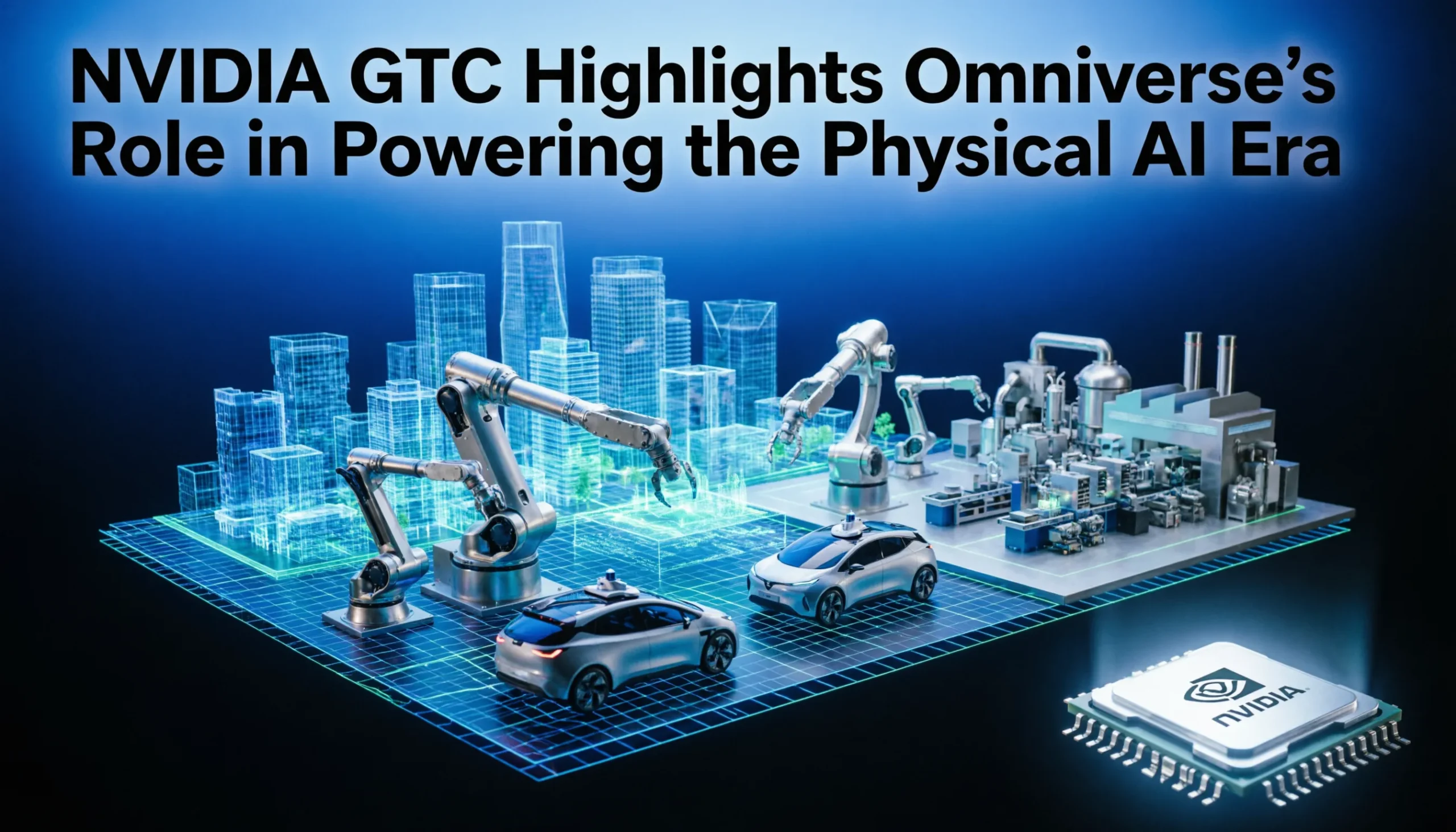
NVIDIA GTC Signals a New Era of Physical AI Powered by Omniverse and Simulation
NVIDIA’s latest GPU Technology Conference (GTC) marked a pivotal moment in the evolution of artificial intelligence—one where digital intelligence is no longer confined to software environments but is rapidly extending into the physical world. From robotics and autonomous vehicles to large-scale industrial systems, physical AI is transitioning from isolated pilot projects into scalable, enterprise-grade deployments across industries.
What emerged from GTC is a clear message: the future of AI lies not just in models, but in ecosystems—where simulation, data generation, and real-world deployment operate as a unified pipeline. At the center of this transformation is NVIDIA’s expanding stack of physical AI technologies, combining advanced models, simulation frameworks, and data infrastructure into a cohesive platform.
From Experimental Robotics to Scalable Physical AI Systems
Historically, physical AI applications—such as warehouse robots or autonomous machines—have been limited to narrow, task-specific deployments. These systems often required extensive real-world testing, bespoke engineering, and significant operational overhead.
At GTC, NVIDIA demonstrated how this paradigm is shifting. Robots, vehicles, and smart factories are now being developed as scalable systems capable of handling complex, multi-domain tasks. This transition is fueled by a new generation of AI models purpose-built for physical environments.
Among the key innovations introduced were NVIDIA Cosmos 3, Isaac GR00T N1.7, and Alpamayo 1.5—frontier models designed to enable machines to understand, simulate, and interact with the real world more effectively. These models represent a move toward generalization in robotics, where systems can adapt to a wide variety of tasks rather than being confined to a single function.
Blueprints for the Physical AI Stack
A major highlight of the conference was NVIDIA’s introduction of structured “blueprints” designed to standardize and accelerate physical AI development.
The NVIDIA Physical AI Data Factory Blueprint addresses one of the most persistent challenges in AI: data. Traditional approaches rely heavily on real-world data collection, which is expensive, time-consuming, and inherently limited. NVIDIA’s approach reframes the problem entirely—leveraging compute power to generate synthetic, high-quality training data at scale.
Complementing this is the Omniverse DSX Blueprint, which focuses on simulation at the infrastructure level. It provides a reference architecture for creating digital twins of AI factories—fully simulated environments that replicate real-world conditions with high fidelity. These digital twins enable organizations to design, test, and optimize systems before any physical deployment takes place.
Together, these blueprints represent a shift toward industrialized AI development, where workflows are standardized, repeatable, and scalable.
Agentic AI Extends Into Operations
Beyond models and simulation, NVIDIA is also pushing AI deeper into operational workflows through agentic frameworks. Open-source platforms like OpenClaw are extending the AI stack into real-world execution, enabling autonomous systems to manage tasks over extended periods.
These systems—referred to as “claws”—are capable of using tools, retaining memory, and communicating across systems to orchestrate complex workflows. This allows organizations to automate not just individual tasks, but entire processes, from data pipeline management to system monitoring.
The implication is significant: AI is no longer just a decision-support tool—it is becoming an active participant in operations, capable of executing and adapting in real time.
OpenUSD: The Foundation of Scalable Simulation
A critical enabler of this ecosystem is OpenUSD (Universal Scene Description), which serves as a unifying language for representing 3D environments and physical systems.
OpenUSD allows teams to integrate data from multiple sources—including CAD designs, simulation assets, and real-world telemetry—into a single, coherent representation. This shared framework ensures consistency across design, simulation, and deployment stages.
By standardizing how physical environments are described and simulated, OpenUSD eliminates one of the major bottlenecks in physical AI development: fragmentation. Teams can now collaborate more effectively, reuse assets, and scale their workflows across projects and domains.
Simulating the AI Factory Before It Exists
Modern AI factories are highly complex systems, involving intricate interactions between compute infrastructure, thermal management, power distribution, and networking. Designing and deploying these facilities without prior validation can lead to inefficiencies and costly delays.
NVIDIA’s Omniverse DSX Blueprint addresses this challenge by enabling full-scale simulation of AI factories before construction begins. Using digital twins, organizations can model every aspect of the facility, from hardware layout to energy consumption, and optimize performance under various conditions.
This simulation-first approach reduces risk, accelerates deployment timelines, and ensures that systems operate efficiently from day one. It also reflects a broader trend in engineering, where virtual validation is becoming a prerequisite for physical implementation.
Rethinking Data: From Scarcity to Abundance
One of the most transformative ideas presented at GTC is the notion that “compute is data.” In traditional AI pipelines, access to large volumes of real-world data has been a key competitive advantage. However, this approach does not scale effectively in complex, unpredictable environments.
NVIDIA’s Physical AI Data Factory Blueprint changes this equation by using simulation and generative models to create synthetic datasets. Built on Cosmos world models and the OSMO operator, the system integrates data curation, augmentation, and evaluation into a single pipeline.
This enables developers to generate diverse, high-quality datasets from limited real-world inputs, effectively removing data scarcity as a constraint. Instead of relying on rare edge cases occurring in the real world, developers can simulate them on demand.
Leading organizations—including FieldAI, Hexagon Robotics, Linker Vision, Milestone Systems, Skild AI, and Teradyne Robotics—are already leveraging this approach to accelerate development across robotics, computer vision, and autonomous systems.
Cloud platforms such as Microsoft Azure and Nebius are further amplifying this capability by offering the blueprint as a service, transforming large-scale compute resources into turnkey data generation engines.
From Design to Deployment: A Seamless Workflow
A key challenge in physical AI development is bridging the gap between engineering design and operational deployment. NVIDIA is addressing this through a streamlined workflow that converts CAD data into simulation-ready assets using OpenUSD.
Tools such as Omniverse Kit and Isaac Sim enable developers to optimize 3D data for real-time rendering and physics-based simulation. This allows teams to test and validate systems in virtual environments that closely mirror real-world conditions.
Companies like FANUC and Fauna Robotics are already using this pipeline to accelerate robotic system development, reducing both time-to-market and development costs.
Industrial Digital Twins Transform Manufacturing and Logistics
The concept of digital twins is reshaping how industries approach manufacturing and logistics. By creating virtual replicas of facilities, organizations can design, test, and optimize operations before implementing them in the real world.
NVIDIA’s Mega Omniverse Blueprint extends this concept to large-scale industrial environments, enabling the simulation of entire factories and warehouse systems. These digital twins can incorporate robot fleets, AI agents, and operational workflows, providing a comprehensive view of system performance.
For example, KION—working with Accenture and Siemens—is using this technology to build advanced warehouse simulations for GXO. These environments are used to train and validate autonomous forklifts powered by NVIDIA Jetson modules, ensuring efficient and reliable operation in real-world settings.
Bridging Simulation and Reality
While simulation plays a central role, the ultimate goal of physical AI is real-world deployment. NVIDIA is working closely with a global ecosystem of robotics and industrial partners to bridge this gap.
Major robotics companies—including ABB, FANUC, KUKA, and Yaskawa—are leveraging NVIDIA’s Omniverse and Isaac platforms to validate complex applications and production lines. These companies, which collectively manage millions of deployed robots, are integrating NVIDIA Jetson modules to enable real-time AI inference at the edge.
At the same time, AI developers such as FieldAI and Skild AI are building advanced robot “brains” using Cosmos world models. These systems are trained in simulation and then deployed in real-world environments, where they can perform a wide range of tasks with increasing autonomy.
Toward General-Purpose Robotics
One of the most significant outcomes of this ecosystem is the emergence of general-purpose robotics. By combining synthetic data generation, high-fidelity simulation, and advanced AI models, developers are creating systems that can adapt to diverse tasks.
Whether it’s monitoring supply chains, managing warehouses, or delivering goods, these robots are becoming more versatile and capable. The ability to train across a wide range of scenarios—both real and simulated—enables rapid skill acquisition and continuous improvement.
NVIDIA GTC made it clear that physical AI is entering a new phase—one defined by scalability, integration, and industrial relevance. The convergence of simulation, data generation, and real-world deployment is transforming how intelligent systems are built and operated.
At the heart of this transformation is NVIDIA’s Omniverse platform, which serves as the connective tissue between virtual and physical worlds. By enabling organizations to design, simulate, and deploy systems within a unified framework, it is accelerating the transition from concept to reality.
As industries increasingly adopt these technologies, the boundaries between digital and physical systems will continue to blur. The result is a new era of AI—one where intelligent machines are not just tools, but active participants in the physical world.
Source link: https://blogs.nvidia.com