Robotics Startup Tackles Multi-Tenant Housing’s Biggest Electrification Barrier with AI-Driven Fleet Solution
What happens when 30% of urban EV owners can’t charge where they live? They return to gas-powered vehicles, undermining climate goals and stranding billions in automotive electrification investment. This infrastructure gap—where older condominiums and rental buildings lack the electrical capacity for fixed charging stations—has quietly become one of the most significant barriers to mass EV adoption. Kiwi Charge, an Ontario-based robotics and AI startup, just secured $1.7 million in government and industry funding to solve it with autonomous mobile charging units that eliminate the need for costly electrical upgrades.
The funding, anchored by Ontario’s government and industry partners including General Motors Canada and the Ontario Vehicle Innovation Network (OVIN), will accelerate prototype development, pilot programs with real estate operators and automotive dealerships, and talent acquisition within Ontario’s AI ecosystem.
Why Fixed Infrastructure Fails Multi-Tenant Buildings
Traditional EV charging infrastructure assumes available electrical capacity and ownership control—two conditions largely absent in urban multi-tenant housing. Installing Level 2 chargers in older buildings often requires panel upgrades, transformer replacements, and rewiring parking structures, with costs reaching tens of thousands of dollars per stall. For rental buildings and condominiums operating on thin margins or locked into long-term capital plans, these economics don’t work.
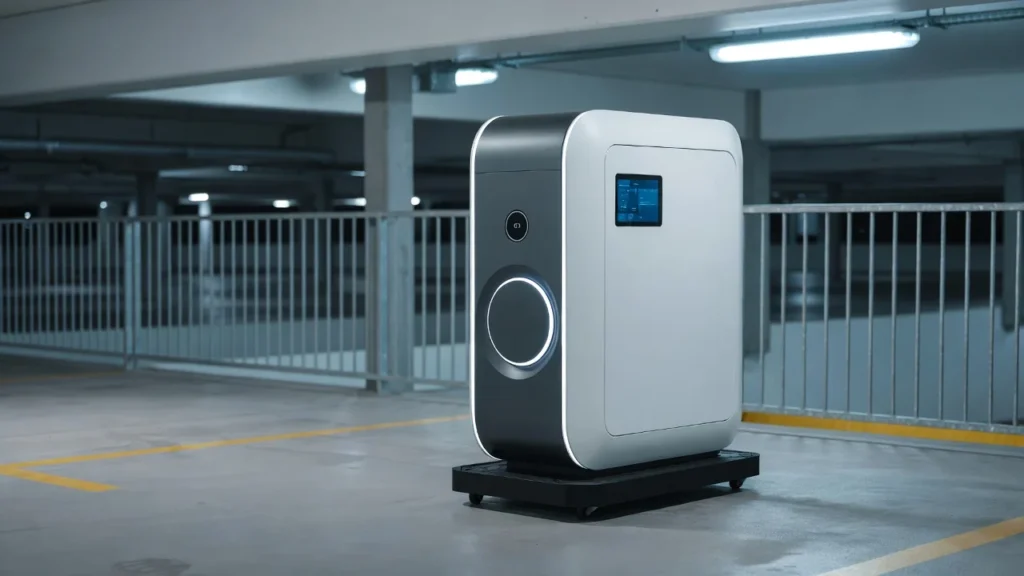
The result is a geographic inequality in EV access. Homeowners install chargers in their garages; apartment dwellers circle blocks hunting for public fast chargers or abandon EVs entirely. Kiwi Charge’s approach inverts the model: instead of bringing power to fixed points, it brings charging capacity to vehicles on-demand using autonomous mobile units equipped with AI-based fleet intelligence.
These units navigate parking garages without human intervention, dynamically prioritizing vehicles based on charge levels and departure schedules. By serving multiple EVs sequentially rather than one vehicle per fixed charger, the system maximizes utilization and reduces grid impact during peak hours—a critical consideration as utilities manage rising electricity demand.
Key Insights at a Glance
- Funding allocation: $1.7M directed toward rapid prototyping, real-world pilots, hiring, and leveraging Ontario’s AI infrastructure for iterative development
- Target market pain point: 30% of urban EV owners live in buildings where fixed chargers are cost-prohibitive due to electrical limitations
- Dual application: Autonomous units for residential parking garages; manual mobile units for automotive dealerships managing high-turnover EV inventory
- Infrastructure advantage: No rewiring required, enabling electrification of older buildings without major capital expenditures or construction downtime
- Strategic alignment: Supports Ontario’s climate, housing affordability, and innovation economy priorities simultaneously
From Dealership Lots to Downtown Parking Garages
While residential buildings represent the primary use case, Kiwi Charge is simultaneously developing manual mobile units for automotive dealerships—a market facing its own charging bottleneck. EV inventory on dealership lots requires constant charge management to maintain display readiness and facilitate test drives. Fixed chargers create layout constraints and idle time; mobile units allow flexible fleet management without disrupting lot operations or customer flow.
“GM Canada’s support of Kiwi Charge reflects our commitment to innovative thinking in sustainable mobility,” said Regan Dixon, Senior Manager at General Motors Canadian Technical Centres. The automaker’s involvement signals recognition that infrastructure gaps threaten EV sales momentum as aggressively as vehicle design or battery costs.
For Ontario, the project represents strategic economic positioning. “By empowering homegrown companies to accelerate the journey of next-generation EV charging solutions from concept to market, our province is not only leading the EV revolution, but also bringing made-in-Ontario innovations to global value chains,” said Raed Kadri, Head of OVIN.
Scaling Beyond Proof-of-Concept
The question for any robotics venture is whether the technology can escape the pilot trap—endless demonstrations that never reach commercial scale. Kiwi Charge’s funding structure mitigates this risk by embedding real estate and automotive partners from the outset, ensuring product-market fit validation during development rather than after.
CEO Abdel Ali frames the opportunity as infrastructure leapfrogging: “The support we have from OVIN and our industry partners gives us the credibility and platform we need to accelerate the development of our high-impact technology that will enable buildings to leapfrog outdated models and adopt clean, flexible EV charging at scale.”
As cities mandate EV-ready buildings in new construction, the question becomes how to retrofit the existing stock—millions of parking spaces built before electrification was conceivable. Autonomous mobile charging doesn’t require perfect infrastructure. It works with what exists, which may prove its most disruptive feature.
About Kiwi Charge
Kiwi Charge Inc. is a Canadian robotics and AI company reimagining EV charging for buildings. Its autonomous charging robots deliver flexible, on-demand service without costly infrastructure upgrades to enable fast, affordable electrification in dense urban environments at 40% of the cost of current solutions. For additional information, visit kiwicharge.ca.
About General Motors Canada
General Motors of Canada is headquartered in Oshawa, Ontario and is part of a global company that is committed to delivering safer, better, and more sustainable ways for people to get around. In Canada, General Motors markets Chevrolet, Buick, GMC and Cadillac vehicles through our strong Canadian network of dealers, as well as OnStar services. More information can be found at www.gm.ca or by following @GMCanada on Instagram.
About OVIN
The Ontario Vehicle Innovation Network (OVIN) is an initiative of the Government of Ontario, led by the Ontario Centre of Innovation (OCI), designed to reinforce Ontario’s position as a North American leader in advanced automotive technology and smart mobility solutions such as connected vehicles, autonomous vehicles and electric and low-carbon vehicle technologies.
Though resources such as research and development (R&D) support, talent and skills development, technology acceleration, business and technical supports, and demonstration grounds, OVIN provides a competitive advantage to Ontario-made automotive and mobility technology companies.
For additional information, please visit: https://www.ovinhub.ca/