
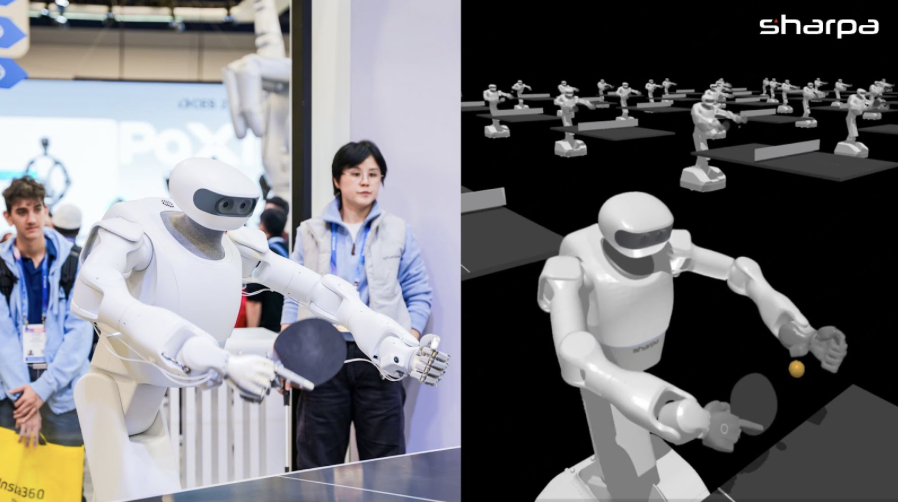
Why are current simulation methods for robot training falling short, and how can they be improved? Sharpa, a leading AI robotics company, is addressing this challenge by collaborating with NVIDIA to develop Tacmap, a high-fidelity simulation framework. This innovation aims to accelerate the deployment of robots capable of complex manipulation tasks in both consumer and enterprise markets.
Sharpa’s latest research, conducted in partnership with NVIDIA, demonstrates significant advancements in simulation methods for robot training. The company leverages two primary approaches: Reinforcement Learning (RL) in virtual environments and the generation of synthetic data for pre-training its Vision Tactile Language Model (VTLA). Tacmap, developed in cooperation with NVIDIA, overcomes the traditional trade-off between physical authenticity and computation speed by using a shared, high-fidelity geometric representation. This breakthrough will be open-sourced to benefit the broader robotics community.
“This collaboration strengthens the foundation for training in simulation, advancing the robotics field towards more dexterity and autonomy and accelerating large-scale deployment,” said Alicia Veneziani, Global VP of Go-To-Market and President of Europe at Sharpa.
The current landscape of robot training simulations often forces a choice between physical accuracy and computational efficiency. This trade-off limits the ability to train robots for complex, real-world tasks. Sharpa and NVIDIA’s collaboration addresses this issue by developing Tacmap, a simulation framework that maintains high fidelity while optimizing computational performance. This advancement is crucial for accelerating the deployment of robots capable of intricate manipulation tasks, which are essential in both consumer and enterprise settings.
Just as a conductor orchestrates a symphony, Sharpa and NVIDIA are harmonizing the elements of high-fidelity simulation and advanced robotics. By integrating Tacmap with Sharpa’s VTLA and NVIDIA’s GEAR Lab, the companies are creating a seamless workflow for training robots. This collaboration not only enhances the dexterity and autonomy of robots but also ensures that they can be deployed at scale. The open-sourcing of simulation and code assets further democratizes access to these cutting-edge technologies, fostering innovation across the industry.
Sharpa is at the forefront of developing dexterous robotic hands, with its Wave hand leading the charge. This human-scale robotic hand features 22 active degrees of freedom and tactile sensors, enabling it to perform tasks with millimeter-level precision. NVIDIA’s GEAR Lab researchers have successfully transferred policies from the GR00T model, pre-trained on over 20,000 hours of human videos, to robots equipped with Sharpa’s Wave hands. The results are impressive: a 54% higher success rate in tasks such as assembling model cars, operating syringes, and sorting cards. This achievement underscores the potential of video data-based training to scale effectively on robots with highly anthropomorphic hands.
The future of robotics is rapidly evolving, and Sharpa’s collaboration with NVIDIA is a significant step forward. The company’s membership in the NVIDIA Inception program and its upcoming presentation at GTC 2026 will further solidify its position as a leader in the field. As Sharpa continues to innovate, the integration of high-fidelity simulation and advanced robotics will pave the way for more productive and versatile robots. The company’s commitment to open-sourcing its simulation and code assets ensures that the benefits of this research will be widely accessible, driving the industry towards new heights.
Sharpa and NVIDIA’s collaboration is reshaping the landscape of robot training and deployment. For businesses in consumer and enterprise markets, this means more dexterous and autonomous robots capable of handling complex tasks. How is your organization preparing to leverage these advancements? Join the conversation in the comments below.
About Sharpa
Founded in 2024, Sharpa is a unicorn AI robotics company dedicated to developing high-performance dexterous robots, systems and components for general-purpose applications. Sharpa’s mission is to build robots that free people from repetitive or strenuous work to focus on more meaningful pursuits. Sharpa’s global headquarters is in Singapore, with manufacturing R&D in Shanghai and business operations in Mountain View, USA.
Source link: https://www.businesswire.com/