
IEEE Approves Panasonic Holdings’ Nessum Technology as the IEEE 1901-2026 Standard for Power Line Communications
Panasonic Holdings Corporation (Panasonic HD) announced that Nessum(*1), a communication technology whose development and standardization activities it has led, has been approved by the Board of Directors of the IEEE Standards Association (IEEE SA)(*2) as the international standard IEEE 1901-2026(*3).
Nessum is a communication technology that can be used over a variety of communication media (Any Media), including existing wiring such as power lines, control lines, coaxial cables, and twisted-pair cables, as well as wireless and underwater communication media. IEEE 1901-2026 is the latest comprehensive standard integrating IEEE 1901-2020(*4), IEEE 1901b-2021(*5), which enhanced authentication functions, and IEEE 1901c-2024(*6), which expanded the range of supported communication media. Panasonic HD and Nessum Alliance(*7) member companies have played a central role in promoting the standardization of these technologies.
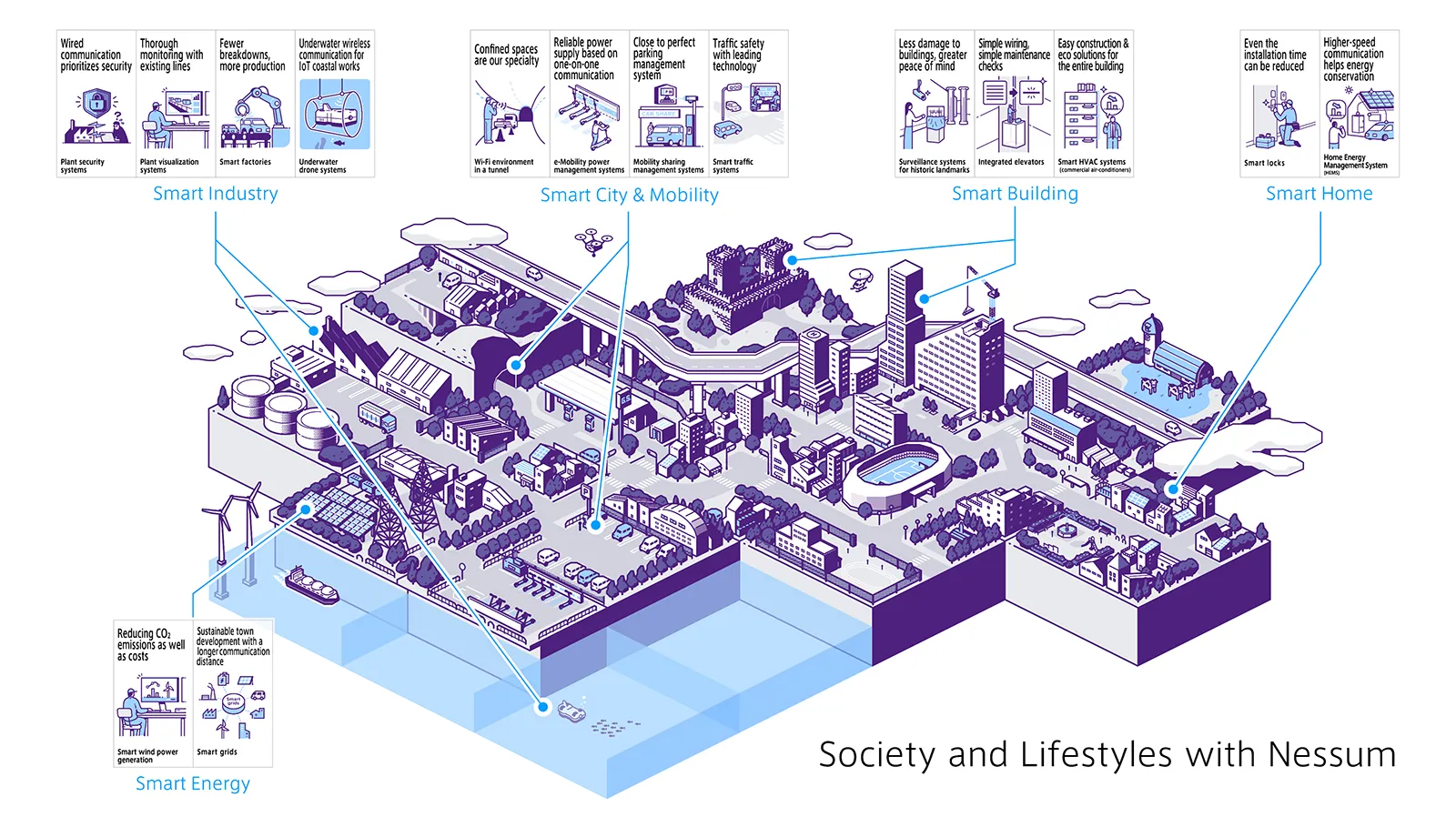
In recent years, the need for efficient networking and control of large numbers of devices has been increasing in smart grid and building automation applications, driven by decarbonization initiatives, the advancement of energy infrastructure, and growing electricity consumption from data centers associated with expanding AI demand. Nessum is gaining adoption in a wide range of energy management and infrastructure applications(*8), not only as a wired communication technology that leverages existing wiring, but also as a flexible technology applicable to wireless and underwater communications.
For many years, Panasonic HD has promoted technology development and international standardization activities related to the IEEE 1901 series. The company has also designed, developed, and licensed semiconductor IP cores compliant with international standards, supporting semiconductor and equipment manufacturers in developing products that conform to IEEE standards. In addition, Panasonic HD works closely with member companies of the Nessum Alliance to ensure interoperability, cultivate markets, and expand the ecosystem.
Through these efforts, Nessum technology has been adopted in a wide variety of products, including commercial HVAC systems and smart grid equipment. The cumulative shipment volume of LSI devices incorporating Nessum semiconductor IP cores has exceeded six million units(*8). In recent years, its application has further expanded as a communication technology supporting energy management, facility control, and the digital transformation of power infrastructure, steadily accumulating practical deployment experience and operational know-how in the market.
The newly approved IEEE 1901-2026 integrates IEEE 1901-2020, IEEE 1901b-2021, and IEEE 1901c-2024, while incorporating knowledge gained through market deployments and operational experience. Combining high-speed and long-distance communication, strong reliability and security, and adaptability to diverse communication media, it serves as a common foundation technology for the growing Nessum ecosystem already being deployed across smart grids, building automation systems, commercial HVAC equipment, surveillance cameras, and industrial devices.
In addition, Nessum has been adopted as a wiring harness for robots and construction machinery because it delivers both power and communications over a single cable, reducing wiring complexity. At the same time, advances in AI are accelerating interest in Physical AI, which enables the real-time sensing, understanding, and control of physical equipment and facilities. In the future, Nessum is expected to contribute to the realization of advanced autonomous control systems by providing a reliable communication infrastructure connecting diverse sensors, actuators, and equipment.
Panasonic HD will continue contributing to IEEE standardization activities while promoting broader global adoption of Nessum technology through licensing semiconductor IP cores compliant with international standards and collaborating with member companies of the Nessum Alliance. The company will also contribute to the digitalization and advancement of social infrastructure, including smart grids and building automation systems, helping to realize a more sustainable society.
About the Panasonic Group
Founded in 1918 in Osaka, Japan, the Panasonic Group is committed to realizing “an ideal society with affluence both in matter and mind.” The Group consists of Panasonic Holdings Corporation, six major operating companies, and affiliated companies in Japan and around the world. Today, the Panasonic Group provides technologies, products, and solutions globally that help address societal challenges across a broad range of business areas. These include Devices area that supports AI infrastructure, such as batteries, electronic devices, and industrial devices; Solutions area for social operations, including B2B solutions, air quality and air-conditioning, cold chain, electrical equipment, and lighting; and Smart Life area centered on consumer products and services. Panasonic Holdings Corporation reported consolidated net sales of 8,048.7 billion yen for the fiscal year ended March 31, 2026. To learn more about the Panasonic Group, please visit: https://holdings.panasonic/global/